

 English









































































RCIP Canada 2026: Process, Requirements, Communities, and Work Permit


If you are trying to immigrate to Canada in 2026, you already know the major city pathways are saturated. The Comprehensive Ranking System (CRS) scores for general Express Entry draws remain painfully high, and the cost of living in Toronto or Vancouver is pushing out new arrivals.
But there is a backdoor. A highly effective, government-backed backdoor designed explicitly to bypass the massive applicant pools: The Rural Community Immigration Pilot (RCIP).
Officially launched to replace the immensely successful Rural and Northern Immigration Pilot (RNIP), the RCIP is the Canadian government’s master plan to funnel skilled talent into smaller towns. If you can secure a job in one of the 14 participating communities, your age and a hyper-competitive CRS score no longer matter. You are put on a direct, dedicated fast-track to permanent residency.
Whether you are a tradesperson, a healthcare professional, or an international student looking for the safest route to stay in Canada, understanding the RCIP Canada 2026 landscape is your competitive advantage. Here is the complete breakdown of the requirements, the step-by-step process, and how to get your work permit while you wait.
Table of Contents
- What is the Rural Community Immigration Pilot (RCIP)?
- RCIP Requirements 2026 (The Eligibility Checklist)
- International Student Exemptions
- The 14 Participating Communities (2026 Updates)
- The RCIP Process Canada: Step-by-Step
- The 2-Year RCIP Work Permit (Start Working Immediately)
- Expert Insight: Navigating Priority NOCs
- Frequently Asked Questions (FAQ)
What is the Rural Community Immigration Pilot (RCIP)?
The RCIP is an employer-driven economic immigration program. It allows eligible businesses in designated rural communities to hire foreign workers from outside of Canada (or transition temporary workers already in Canada) directly into permanent residency.
Unlike Express Entry, which relies on a massive point-based competition, the RCIP relies on community recommendation. If a participating town decides they need your specific skill set to boost their local economy, they issue you a recommendation certificate. IRCC (Immigration, Refugees and Citizenship Canada) then processes your permanent residence application based on that local endorsement.
RCIP Requirements 2026 (The Eligibility Checklist)
To qualify for the RCIP, you must meet both federal IRCC requirements and the specific requirements of the community you are applying to.
Here are the strict federal baselines for 2026:
1. The Job Offer Requirement
You cannot apply for the RCIP without a job offer. The offer from a designated employer within the community boundaries must be:
- Full-time (at least 30 paid hours per week).
- Non-seasonal (year-round).
- Indeterminate (no end date).
- Aligned with the required wage threshold (e.g., some communities require $21.00/hour or the Job Bank median wage, whichever is higher).
2. Work Experience
You must have at least 1 year (1,560 hours) of continuous or non-continuous related work experience in the past 3 years.
- Your past experience must match the NOC TEER category of your new job offer.
- Exception: If your job offer is TEER 0 or 1, your past experience can be TEER 0, 1, 2, or 3. If your job offer is TEER 5, your experience must be in the exact same 5-digit NOC code.
3. Language Proficiency (Approved Tests)
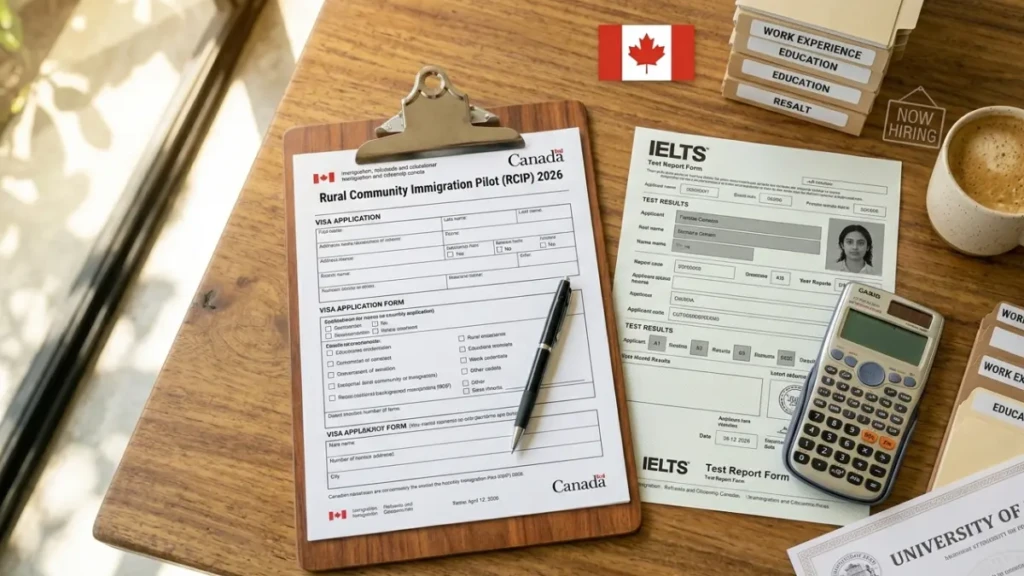
You must take an approved language test (CELPIP, IELTS General, or PTE Core for English). The minimum score depends on the job you are offered:
- TEER 0 or 1: CLB 6 minimum.
- TEER 2 or 3: CLB 5 minimum.
- TEER 4 or 5: CLB 4 minimum.
4. Educational Credentials
You need a minimum of a Canadian secondary school (high school) diploma or a foreign equivalent. If educated outside Canada, you must provide an Educational Credential Assessment (ECA) report that is less than 5 years old.
5. Proof of Funds
If you are applying from outside of Canada (and are not currently working legally in Canada), you must prove you have enough liquid cash to support yourself and your family as you settle into the community.
International Student Exemptions
If you are an international student, you can completely bypass the 1-year work experience requirement. To qualify for this massive shortcut, you must have graduated from a public post-secondary school located inside the participating community with:
- A credential from a program of 2+ years (you must have lived in the community for at least 16 of the last 24 months of study).
- OR a Master’s degree or higher completed in 2 years or less (you must have lived in the community for the entire length of your studies).
- You must apply for PR within 18 months of getting your credential.
The 14 Participating Communities (2026 Updates)
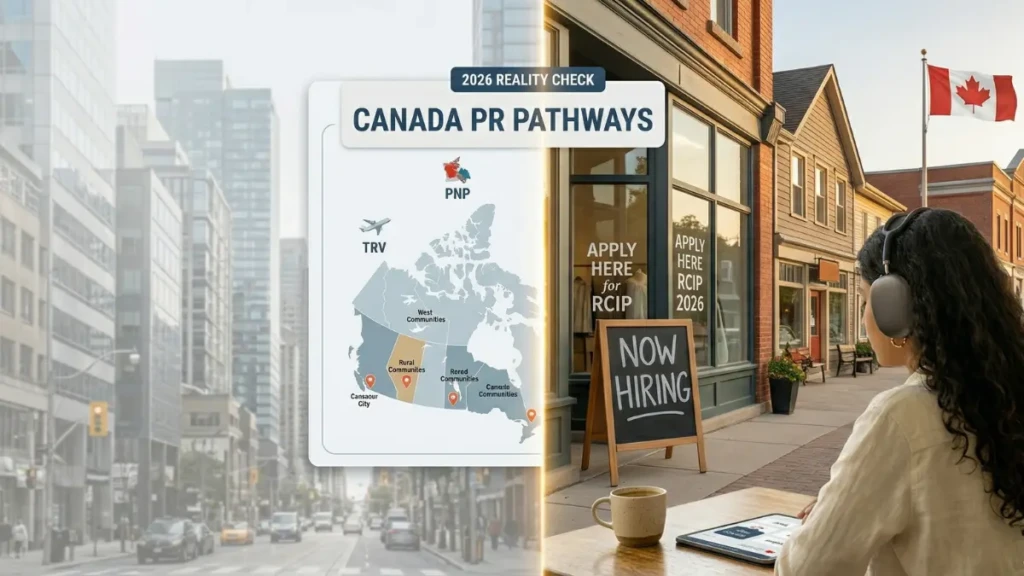
The transition from RNIP to RCIP narrowed the focus to 14 highly specific communities across Canada. Each community manages its own intake caps, priority sectors, and monthly draws.
While IRCC oversees the final PR processing, these are the regions you need to target for your job search:
- British Columbia: West Kootenay, Peace Liard (Northeast BC)
- Manitoba: Brandon, Steinbach
- Saskatchewan: Moose Jaw
- Ontario: Sault Ste. Marie(Note: A complete list of all 14 communities is updated dynamically on the IRCC portal).
Community Quirks: Every town has its own rules. For example, in 2026, West Kootenay accepts 25 applications per month on a first-come, first-served basis, heavily prioritizing Healthcare, Education, and Trades. Steinbach processes intakes on the 1st of every month, issuing just 5 recommendations per round. You must study the specific economic development website of the town you choose.
The RCIP Process Canada: Step-by-Step
Understanding the RCIP process Canada is critical because it requires deep coordination between you and your future employer.
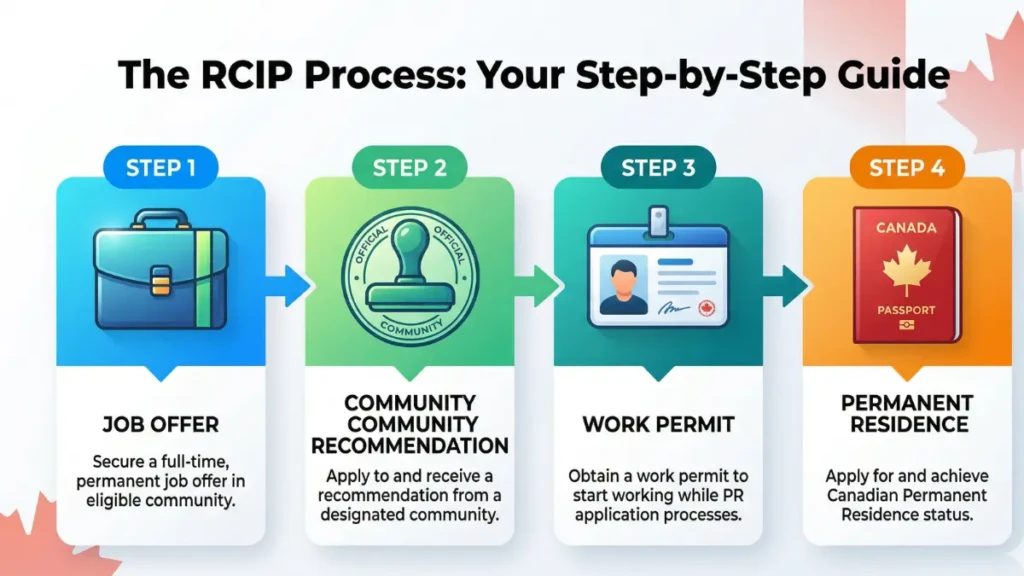
- Step 1: Find a Designated Employer. Search job boards specific to the 14 communities. You must secure a valid job offer from an employer who is officially “designated” by the town’s economic development board to participate in the RCIP.
- Step 2: The Employer Applies for Recommendation. Once you have the job offer and gather your documents (language tests, ECA), your employer submits your application to the community’s RCIP committee during their monthly intake window.
- Step 3: Receive the Community Recommendation Certificate. If the town selects you, they issue a certificate valid for 6 months.
- Step 4: Apply for Permanent Residence. You take that certificate and submit your official PR application directly to IRCC online.
- Step 5: Apply for the Optional Work Permit. While IRCC processes your permanent residency, you can apply for an RCIP-specific work permit so you can move to the community and start earning money immediately.
The 2-Year RCIP Work Permit (Start Working Immediately)
One of the biggest anxieties immigrants face is the 12+ month processing time for PR. The RCIP solves this elegantly.
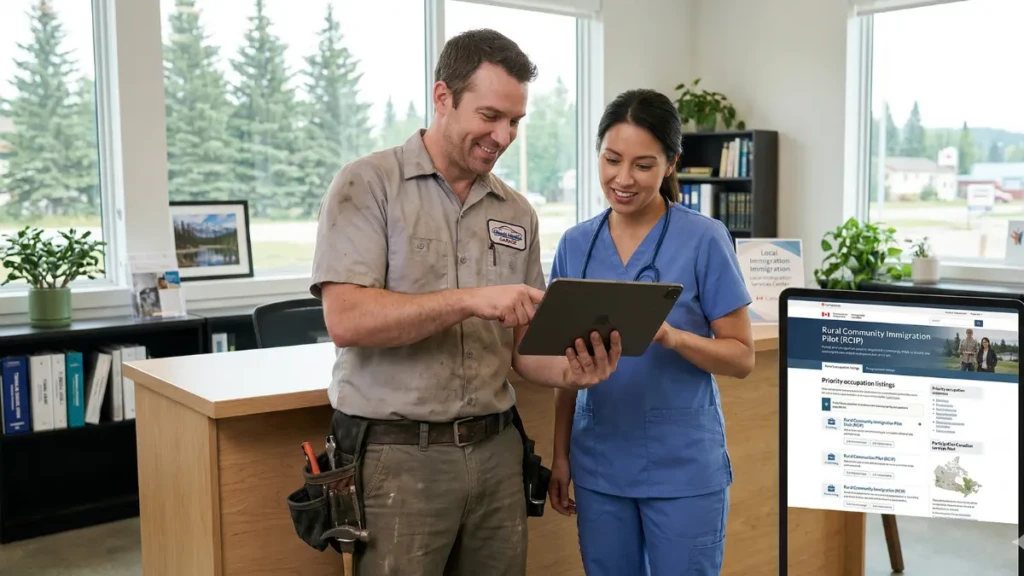
If you have a Community Recommendation and have submitted your PR application, you are eligible to apply for a 2-year RCIP work permit.
Key Details:
- It is a closed work permit, meaning you can only legally work for the employer who offered you the job.
- It is valid for exactly 2 years, giving IRCC more than enough time to finalize your permanent residency.
- Spousal Support: Your spouse or common-law partner can apply for an open work permit at the exact same time. Their permit allows them to work for any employer, as long as it is within the boundaries of the same rural community.
Expert Insight: Navigating Priority NOCs and Employer Caps

We spoke with a regional RCIP coordinator to understand why some applications are rejected even if the candidate meets the baseline federal requirements.
“In 2026, the biggest mistake candidates make is ignoring local employer caps. IRCC limits how many recommendations a single business can issue. For example, a restaurant with 50+ employees might only be allowed to submit 4 RCIP applications per year. If you are candidate number 5, you will be rejected regardless of your qualifications. Always ask a prospective employer upfront: ‘Do you have RCIP recommendation allocations available for this calendar year?’ Focus heavily on Priority NOCs (like Nurses, Early Childhood Educators, and Heavy Duty Mechanics)—these sectors are often exempt from standard employer caps.”
Frequently Asked Questions (FAQ)
Can I move to a different city after getting PR through the RCIP?
When you apply through the RCIP, you must sign a declaration stating your clear intent to reside in that specific community. Moving away immediately after receiving your PR card can trigger an investigation for misrepresentation. While the Canadian Charter of Rights and Freedoms guarantees mobility rights to permanent residents, you are expected to make a genuine, sustained effort to settle in the community that sponsored you.
Do I need an LMIA for the RCIP Work Permit?
No. The RCIP 2-year work permit is LMIA-exempt. Your employer simply needs to pay the employer compliance fee and provide you with an offer of employment number through the IRCC Employer Portal.
What happens if I lose my job while on the RCIP Work Permit?
Because the work permit is tied directly to your specific employer, losing your job means you cannot legally work for anyone else. You would need to find another designated employer within the community willing to hire you and apply for a new RCIP work permit, or risk your PR application being cancelled if you cannot fulfill the program requirements.
Are distance learning programs eligible for the International Student Exemption?
No. If distance learning (online classes) made up more than half of your study program, you are not eligible for the international student exemption and must complete the standard 1-year work experience requirement instead.
Secure Your Spot Before the Caps Hit
The RCIP Canada 2026 program is a lifeline for skilled workers tired of the Express Entry bottleneck. But it requires speed. Because communities process applications monthly and operate on strict first-come, first-served quotas, hesitation will cost you your spot. Get your language tests done, secure your ECA, and start aggressively networking with designated employers in rural Canada today.
Looking to maximize your points if you are still pursuing federal streams? Read our guide on [Boosting Your CRS Score with French Language Testing in 2026].
Related Post:
Best Canada PR Pathways in 2026 (Complete Guide for Immigrants)

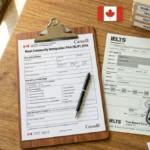
RCIP Requirements 2026: The Complete Eligibility Breakdown
12th Apr 2026[…] RCIP Canada 2026: Process, Requirements, Communities, and Work Permit […]