

 English





















How to Avoid Foreign Transaction Fees: Best US & Canadian Credit Cards (2026)

Imagine tapping your card for a well-deserved dinner in Paris, or perhaps paying a vendor invoice to a US-based supplier. The meal was €100. The invoice was $500 USD. But when you check your bank statement a few days later, the math just doesn’t add up. You’ve been hit with an invisible surcharge.
If you want to know how to avoid foreign transaction fees, you are in the right place. For frequent travelers, digital nomads, and entrepreneurs whose market is the world, these sneaky 2.5% to 3% charges are more than just an annoyance. They are a direct tax on your global ambition.
Whether your goal is to travel hack your way around the globe or keep more of your hard-earned dollars in your own pocket, picking the right credit card is your first line of defense. Let’s break down exactly what these fees are, how they drain your budget, and look at a head-to-head comparison of the best US and Canadian credit cards designed to bypass them entirely.
Table of Contents
- What Are Foreign Transaction Fees?
- Dynamic Currency Conversion: The Traveler’s Trap
- How to Avoid Foreign Transaction Fees
- Best US & Canadian Credit Cards for Frequent Travelers
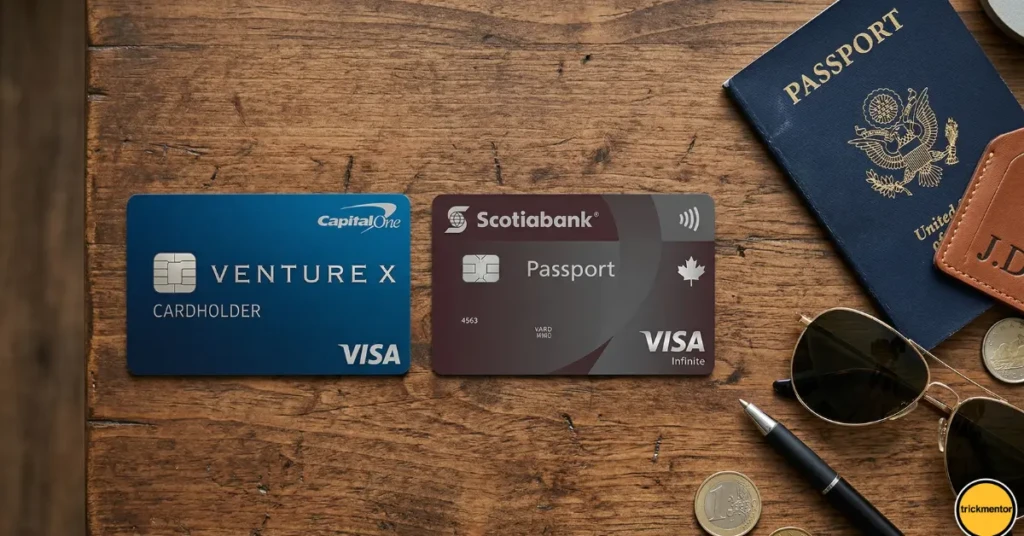
- Side-by-Side Comparison: Venture X vs. Scotiabank Passport
- Expert Insight: Structuring Your Global Spending
- Frequently Asked Questions (FAQ)
What Are Foreign Transaction Fees (And Why Do They Exist)?

A foreign transaction fee (often abbreviated as an FX fee) is a surcharge applied by your credit card issuer every time you make a purchase that passes through a foreign bank or is processed in a non-domestic currency.
It usually consists of two separate charges stacked together:
- The Network Fee: Visa or Mastercard typically charges around 1% for handling the currency conversion.
- The Bank Markup: Your issuing bank tacks on an additional 1.5% to 2% simply because they can.
Together, you’re looking at an average penalty of 3% per transaction in the US, and typically 2.5% in Canada.
How FX Fees Eat Into Your Budget
Let’s do the math. The average international vacation costs roughly $5,000. If you put all those flights, hotels, and meals on a standard cash-back card with a 3% FX fee, you are paying $150 just for the privilege of spending your own money. If you operate a digital business and pay $2,000 a month for US-based software or ad spend using a standard Canadian card, you are bleeding $600 CAD a year in junk fees. That is capital that should be funding your next trip or scaling your business.
Pro Tip: Don’t assume a transaction is safe just because you are sitting on your couch. Buying something online from a server hosted outside your home country can still trigger a foreign transaction fee, even if the price was displayed in your local currency.
Dynamic Currency Conversion (DCC): The Ultimate Traveler’s Trap
Before we talk about credit cards, we need to address the most common mistake travelers make at the checkout counter: Dynamic Currency Conversion (DCC).
Picture this: You are checking out of a hotel in Toronto with your US credit card. The terminal asks, “Would you like to pay in USD or CAD?”
Your brain naturally gravitates toward USD because it’s familiar. Do not click USD. If you choose to pay in your home currency while abroad, the local merchant’s bank sets the exchange rate, not Visa or Mastercard. These merchant rates are notoriously terrible, often hiding a markup of 5% to 7%.
The Rule to Live By: Always choose to pay in the local currency. Let your credit card handle the math on the backend.
How to Avoid Foreign Transaction Fees
Eliminating these charges from your life is surprisingly simple if you set up your wallet correctly. Here is the exact playbook:
- Get a No-FX-Fee Credit Card: This is the most bulletproof method. When your card has a 0% foreign transaction fee, you pay the exact mid-market exchange rate set by Visa, Amex, or Mastercard.
- Decline DCC at the Terminal: As mentioned above, always opt to be charged in the local currency of the country you are visiting.
- Open a Multi-Currency Account: If you do business globally, look into platforms like Wise or Revolut that allow you to hold and spend balances in multiple currencies.
- Check Your Existing Wallet: You might already have a premium travel card. Call the number on the back of your card and ask, “What is my foreign transaction fee?”
Need a deep dive on optimizing personal finances? Check out our guide on [Internal Link: Maximizing Your Travel Reward Strategies] to learn how to compound your points.
Best US & Canadian Credit Cards for Frequent Travelers
If you are a cross-border traveler or building a global income stream, you need a financial tool that works as hard as you do. Let’s look at two absolute titans of the travel card industry: one from the US, and one from Canada.
The US Heavyweight: Capital One Venture X
The Capital One Venture X Rewards Credit Card flipped the premium travel card market upside down when it launched. It is built specifically for frequent travelers who want luxury perks without the agonizing $600+ annual fees of its competitors.
Why it wins for global spending:
- Zero Foreign Transaction Fees: You can swipe this card anywhere in the world without a second thought.
- Massive Earning Potential: It earns 2x miles on every single purchase, making it an incredible everyday driver, whether you’re buying groceries in New York or paying for a taxi in London.
- The Math Makes Sense: Yes, it has a $395 annual fee. However, Capital One gives you a $300 annual travel credit (for bookings through their portal) and 10,000 anniversary miles every year (worth $100). If you travel even once a year, they are effectively paying you $5 to hold the card.
- Lounge Access: Unlimited access to Priority Pass, Plaza Premium, and Capital One Lounges for you and two guests.
According to [External Link: Forbes Advisor’s recent premium card analysis], the Venture X remains one of the highest-value travel cards on the market in 2026 due to its easily justifiable fee structure.
The Canadian Champion: Scotiabank Passport Visa Infinite
Canadian banks are notoriously stingy when it comes to foreign transaction fees. While the US is flooded with no-FX cards, Canadians have to hunt for them. Enter the Scotiabank Passport Visa Infinite.
Why it wins for global spending:
- 0% FX Markup: It completely waives the standard 2.5% foreign transaction fee that almost all other Canadian big-bank cards charge.
- Earning Rate: You earn Scene+ points, picking up 2x points on groceries, dining, entertainment, and daily transit, and 1x points on everything else.
- Lounge Access: It comes with 6 free complimentary airport lounge visits per year via the Visa Airport Companion Program. For a card with a relatively low fee, this is an incredible perk for the occasional traveler.
- Annual Fee: $150 CAD (often waived in the first year depending on current promotions).
Side-by-Side Comparison: Venture X vs. Scotiabank Passport
| Feature | Capital One Venture X (US) | Scotiabank Passport Visa Infinite (CA) |
| Foreign Transaction Fee | None | None |
| Annual Fee | $395 USD | $150 CAD |
| Welcome Bonus | 75,000 Miles (usually after $4k spend) | Up to 40,000 Scene+ Points |
| Lounge Access | Unlimited (Priority Pass + Capital One) | 6 free visits per year |
| Base Earning Rate | 2x Miles on all purchases | 1x Scene+ Point on base purchases |
| Best For | Heavy travelers, US dollar earners | Cross-border shoppers, Canadian travelers |
Expert Insight: Structuring Your Global Spending
Your income might be local, but the world is your market. If you are a digital professional, your tools, subscriptions, and travel expenses are likely billed in USD, Euros, or Pounds.
Stop treating foreign transaction fees as an inevitable cost of doing business or traveling. By pairing a zero-fee credit card with smart spending habits (like rejecting DCC), you instantly give yourself a 2.5% to 3% discount on all international commerce. Treat your financial infrastructure with the same strategic focus you apply to your career or business.
Frequently Asked Questions (FAQ)
What is a foreign transaction fee?
A foreign transaction fee is a surcharge—usually between 2.5% and 3%—that your credit card network and issuing bank charge you for making a purchase in a foreign currency or routing a payment through a foreign bank.
How to know if your credit card has a foreign transaction fee?
The fastest way is to check your card’s “Pricing and Terms” document online, or simply flip your card over and call the customer service number on the back. Ask the representative directly if they apply an FX markup.
How to avoid dynamic currency conversion (DCC)?
Whenever a credit card terminal or ATM abroad asks if you want to be charged in your home currency or the local currency, always select the local currency. This forces your credit card network to handle the exchange rate, saving you from heavy merchant markups.
Is it worth getting a specific travel credit card just to avoid FX fees?
Yes. If you spend even $2,000 to $3,000 a year in a foreign currency (including online shopping or software subscriptions), a no-FX-fee card easily pays for itself, especially when factoring in welcome bonuses and included travel insurance.
Do Canadian banks charge foreign transaction fees on US purchases?
Yes, the vast majority of Canadian credit cards charge a 2.5% markup on US purchases. You must specifically apply for a card with no foreign transaction fees, like the Scotiabank Passport Visa Infinite, or open a USD-specific Canadian credit card to avoid this.
Ready to Upgrade Your Wallet?
Stop leaving money on the table. Whether you’re eyeing the robust rewards of the Capital One Venture X or the practical cross-border utility of the Scotiabank Passport, making the switch takes less than ten minutes.
If you found this guide helpful, check out our [Best Travel Credit Cards 2026 USA: Top Picks for Every Traveler] to discover more ways to maximize your international saving potential during travels across countries.
Also Read:


Building Credit from Scratch: Step-by-Step for US & Canadian
09th Apr 2026[…] How to Avoid Foreign Transaction Fees: Best US & Canadian […]