

 English


































Best Travel Credit Cards 2026: The Ultimate North American Guide


In 2026, the definition of a “good” travel card has changed. With annual fees on the rise and airport lounges hitting capacity limits, the “clout” of carrying a heavy metal card is no longer enough. To win the travel game this year, you need a card that offers more than just shiny marketing—you need a high-yield return on your daily logistics and a clear path to “outsized” redemption value.
Whether you are planning a cross-country road trip or an international business-class hop, choosing between the best travel credit cards requires an analytical look at the Effective Annual Fee (EAF). This is the “sticker price” minus the value of the credits you actually use.
If you are looking for travel rewards credit cards that actually pay for themselves, here is the data-driven breakdown of the top contenders in the US and Canada for 2026.
Table of Contents
- The Premium Heavyweights: Best for Luxury (USA)
- The Mid-Tier Champions: Best for Value (USA)
- North of the Border: The Best Travel Credit Cards (Canada)
- The 2026 Math: Why “Effective Annual Fee” is King
- Expert Insight: The 2026 Lounge Access Reality
- Frequently Asked Questions (FAQ)
1. The Premium Heavyweights: Best for Luxury (USA)
For the high-frequency traveler, these cards are less about “spending” and more about “membership.”
Chase Sapphire Reserve®
- The Vibe: The ultimate all-rounder for flexible travelers.
- 2026 Highlights: Its $300 annual travel credit remains the easiest to use in the industry, automatically applying to everything from tolls to flights.
- Why it Ranks: The 1.5x redemption value through the Chase portal provides a “safety net” for travelers who don’t want to spend hours hunting for transfer partner availability.
The Platinum Card® from American Express
- The Vibe: A lifestyle concierge in your pocket.
- 2026 Highlights: While the $695+ fee is steep, the Centurion Lounge network and Gold status with Hilton and Marriott provide an “elite” experience that competitors struggle to match.
- Strategy: This card is only for those who can naturally maximize the digital entertainment, Uber, and airline fee credits.
2. The Mid-Tier Champions: Best for Value (USA)
If you want the points without the $500+ sticker shock, these are the travel rewards credit cards for the “smart” money.
Chase Sapphire Preferred® Card
- The Vibe: The “Starter Pack” for travel hackers.
- Why it Wins: For a $95 fee, you get access to the same high-value transfer partners (like Hyatt and United) as the Reserve. In 2026, it remains the most recommended card for those who value points over lounges.
Capital One Venture X Rewards Credit Card
- The Vibe: The “Math Masterpiece.”
- Why it Wins: It’s a premium card at a mid-tier price point. With a $395 fee and $400 in annual value (travel credit + anniversary miles), the bank is essentially paying you $5 to hold the card.
3. North of the Border: The Best Travel Credit Cards (Canada)

The Canadian market in 2026 is dominated by Aeroplan and “The Big Five” banks.
American Express® Cobalt® Card
- The Vibe: The “Earn Rate” King.
- Why it Wins: In 2026, its 5x earn rate on food and drinks (groceries/dining) is the highest in Canada. Since these points can be transferred 1:1 to Aeroplan, it is the fastest way to earn a free flight through daily spending.
TD® Aeroplan® Visa Infinite* Card
- The Vibe: The Air Canada frequent flyer’s best friend.
- 2026 Highlights: Free first checked bags and preferred pricing on reward flights make this a “must-have” for anyone regularly flying the Trans-Canada corridor.
4. The 2026 Math: Why “Effective Annual Fee” is King
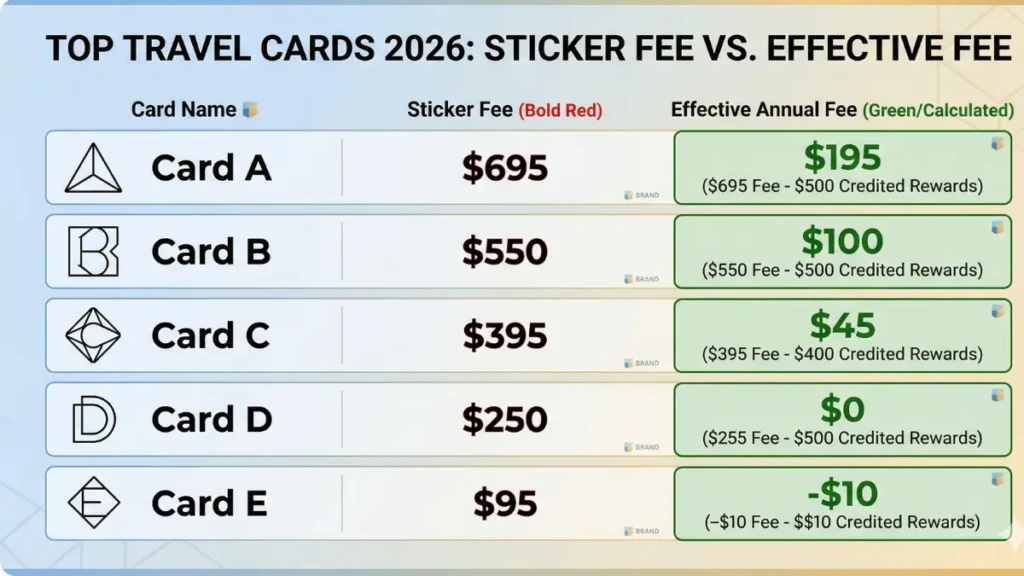
When comparing the best travel credit cards, ignore the annual fee for a moment. Instead, calculate your EAF using this formula:
Annual Fee – (Travel Credits + Monthly Lifestyle Credits + Value of Anniversary Miles) = EAF
If your EAF is negative, the card is a “net gain.” If it’s higher than $100, you are paying a premium for lounge access and insurance. In a year where travel costs are high, ensuring a low EAF is the most important part of your financial strategy.
5. Expert Insight: The 2026 Lounge Access Reality
We asked a travel logistics analyst about the biggest shift in 2026.
“In 2026, the ‘Priority Pass’ that comes with every card has become less valuable due to overcrowding. We are seeing more ‘Lounge Full’ signs than ever before. If lounge access is your priority, look for cards with proprietary networks—like the American Express Centurion lounges or the newer Chase and Capital One lounges. Having a card that gives you access to a lounge with a ‘no guest’ policy is often better than a card that gets everyone in but has a 40-minute wait.”
Frequently Asked Questions (FAQ)
What credit score do I need for the best travel credit cards?
Generally, you need a “Good” to “Excellent” credit score (typically 700+). Premium cards like the Amex Platinum or Chase Sapphire Reserve often require 740+ for a smooth approval process.
Are travel rewards credit cards worth the annual fee?
Yes, but only if you travel at least twice a year and can utilize the built-in credits. If you find yourself “buying” things you don’t need just to use a credit, you are likely better off with a no-fee cashback card.
Can I use these cards for my business travel?
Absolutely. Many performance marketers and entrepreneurs use these cards for their ad spend to accumulate millions of points. However, ensure you are not violating any corporate expense policies if you are an employee.
What is the best way to maximize my travel points in 2026?
The “Transfer Partner” method remains the winner. Instead of booking through a bank’s portal, transfer your points to an airline (like Air Canada or Virgin Atlantic) during a “Transfer Bonus” period to get 20%–30% more value.
Ready to Upgrade Your Travel?
The “best” card isn’t the one with the biggest bonus; it’s the one that aligns with your 2026 lifestyle. Audit your 2025 spending, look at your primary airport hubs, and choose the card that turns your daily logistics into your next grand adventure.
Thinking about how these cards fit into your overall financial plan? Read our guide on [Best Travel Credit Cards 2026 USA: Top Picks for Every Traveler] to fund your next trip faster.