

 English























Should You Book Flights with Points or Cash? The 2026 Math Explained


You are staring at the airline checkout screen. On the left side, the flight costs $450. On the right side, it costs 35,000 points plus $25 in taxes. You have 50,000 points sitting in your account, begging to be used.
Panic sets in. Are you getting a massive deal, or is the airline quietly robbing you of your hard-earned credit card rewards?
If you are trying to figure out whether you should book flights with points or cash, you need to stop relying on your gut feeling and start using a calculator. In 2026, airlines use aggressive “dynamic pricing,” meaning the points required for a flight fluctuate wildly based on demand, algorithms, and time of day.
The secret to winning the travel hacking game is mastering one simple concept: Cent-Per-Point (CPP) value. Let’s break down the exact mathematical formula you need to use before every single booking, and run through real-world examples for US and Canadian travelers to show you exactly what a “good” deal looks like.
Table of Contents
- The Golden Metric: Cent-Per-Point (CPP) Explained
- The Ultimate Points vs. Cash Formula
- Real-World Scenario 1: New York to Los Angeles (US)
- Real-World Scenario 2: Vancouver to Toronto (Canada)
- When to ALWAYS Pay Cash
- When to ALWAYS Use Points
- Expert Insight: The Danger of Hoarding
- Frequently Asked Questions (FAQ)
The Golden Metric: Cent-Per-Point (CPP) Explained
Not all points are created equal. A Delta SkyMile is not worth the same as a Chase Ultimate Reward point, and neither is worth the same as an Air Canada Aeroplan point.
To compare apples to apples, the travel industry uses the Cent-Per-Point (CPP) metric. This simply tells you how many cents of real-world value you are getting out of every single point you redeem.
The 2026 Baseline Valuations: As a general rule of thumb, most credit card points and airline miles have a baseline floor value of 1.0 to 1.5 cents per point. * If your math shows you are getting less than 1.0 cpp, you are losing money. Pay cash.
- If your math shows you are getting 1.5 cpp or higher, you are getting a solid deal. Use points.
- If you hit 2.0 cpp or higher, you have found an exceptional “sweet spot.” Book immediately.
The Ultimate Points vs. Cash Formula
Do not skip this step. The biggest mistake amateur travelers make is dividing the total cash price by the points. You must subtract the taxes and fees you are forced to pay on the award ticket first.
Here is the only formula you will ever need:
Step 1: Cash Price of Ticket – Taxes/Fees on Award Ticket = Cash Savings
Step 2: (Cash Savings ÷ Points Required) x 100 = Your CPP Value
Take a screenshot of that. Write it on a sticky note. Apply it every single time you search for a flight. Let’s see how it works in the real world.
Real-World Scenario 1: New York (JFK) to Los Angeles (LAX)
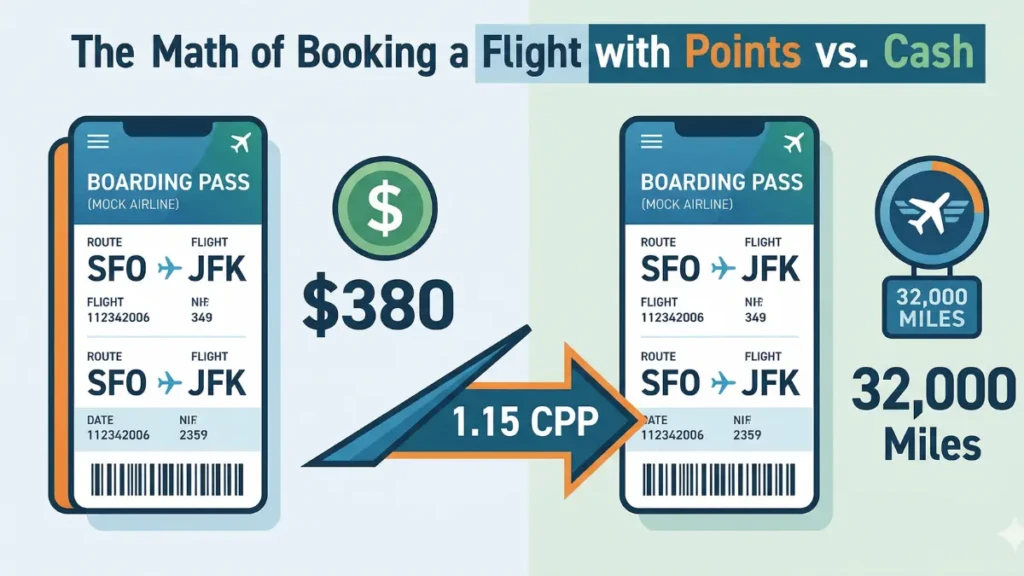
You need to fly cross-country for a wedding. You are looking at a main cabin economy ticket on a major US carrier like Delta or American Airlines.
- The Cash Option: $380 round-trip.
- The Points Option: 32,000 miles + $11.20 in mandatory TSA security fees.
Let’s run the formula:
- Step 1 (Savings): $380.00 – $11.20 = $368.80
- Step 2 (CPP): ($368.80 ÷ 32,000) x 100 = 1.15 cents per point.
The Verdict: At 1.15 cpp, this is an incredibly average redemption. It meets the absolute minimum floor value. If you are cash-poor this month and just want a free flight, use the points. But if you are saving up for a luxury international trip later, pay the $380 cash and save those miles, as they could be worth double on a better route.
Real-World Scenario 2: Vancouver (YVR) to Toronto (YYZ)
You are booking a last-minute business trip across Canada on Air Canada. Because it is last minute, the cash prices are painfully high.
- The Cash Option: $650 CAD round-trip.
- The Points Option: 22,000 Aeroplan points + $85 CAD in airport taxes and fees.
Let’s run the formula:
- Step 1 (Savings): $650.00 – $85.00 = $565.00
- Step 2 (CPP): ($565.00 ÷ 22,000) x 100 = 2.56 cents per point.
The Verdict: Book this with points immediately. Squeezing over 2.5 cents out of an economy ticket is fantastic. Last-minute domestic flights are notoriously expensive in cash, making them one of the best ways to maximize your reward balances in Canada.
Looking to optimize your daily spending to earn more of these points? Review our guide on [Internal Link: The Best Travel Credit Cards for Everyday Groceries in 2026].
When to ALWAYS Pay Cash
Even if you have millions of miles, there are specific scenarios where swiping your credit card is the smarter financial move.
- Cheap “Fare War” Flights: If a flight is on sale for $99, do not use points. Airlines will rarely drop the point requirement low enough to make cheap flights mathematically viable.
- You Are Chasing Elite Status: Award flights (tickets bought entirely with points) generally do not earn elite qualifying miles or segments. If you are one flight away from hitting Gold or Platinum status for the year, you must pay cash to earn the credit.
- Heavy Fuel Surcharges: Some international carriers (looking at you, British Airways) will charge you 40,000 points plus $600 in “carrier-imposed surcharges.” Always run the math. Often, the cash ticket on a competing budget airline is cheaper than the “fees” on your free ticket.
When to ALWAYS Use Points

Conversely, points are designed to rescue you from financial pain. Leverage them heavily in these three situations:
- Last-Minute Emergencies: Airlines gouge travelers who need to fly tomorrow. While a cash ticket might jump from $300 to $900 overnight, the award calendar might still have a seat available for the standard 25,000 points.
- International Business/First Class: This is the holy grail of travel hacking. A $5,000 business class seat to Tokyo might cost 80,000 points. If you run the formula, that equates to a staggering 6.2 cents per point.
- Peak Holiday Travel: Thanksgiving and Christmas cash prices are brutal. If you plan 11 months in advance and secure award space, you bypass the holiday cash surge entirely.
Pro Tip: If you have transferable currency (like Chase Ultimate Rewards or Amex Membership Rewards), check to see if your bank portal offers a fixed redemption rate (like 1.5 cents per point) before transferring them to an airline. Sometimes, booking a cheap cash fare through the bank portal is cheaper than booking an award flight direct with the airline.
Expert Insight: The Danger of Hoarding
We asked financial travel analyst Marcus Vance what the biggest mistake travelers make in 2026 is.
“Points are not a retirement account. They do not earn interest, and they do not appreciate in value. In fact, due to airline devaluations, points are subject to hyper-inflation. A flight that costs 30,000 points today might cost 45,000 next year. The math rule is simple: ‘Earn and Burn.’ If you find a redemption that hits your target CPP, take it. Do not hoard points waiting for a magical trip a decade from now.”
Frequently Asked Questions (FAQ)
Can I mix points and cash to book a flight?
Yes, most major airlines offer a “Miles + Cash” option at checkout. However, the math on these hybrid fares is notoriously terrible. The airline usually gives you less than 1.0 cent per point in value for the points portion. You are almost always better off paying 100% cash or 100% points.
Do I earn frequent flyer miles when I book with points?
No. If you pay for your flight using points, you will not earn new miles for flying that route. You only earn miles on revenue (cash) tickets.
What is the best airline point currency in 2026?
The most valuable currencies are not airline miles at all—they are flexible bank points (Chase Ultimate Rewards, Amex Membership Rewards, Capital One Miles). They allow you to run the math across multiple different airline partners and transfer your points to whichever airline offers the highest CPP value on that specific day.
Is it worth buying airline points with cash?
Usually, no. Airlines sell points at a premium (often 2.5 to 3.5 cents per point). Unless you are just a few thousand points short of a massive, high-value business class redemption, buying points outright is a mathematically losing game.
Stop Guessing, Start Calculating
The next time you reach the checkout screen, don’t let the airline’s marketing pressure you into a bad deal. Open your phone’s calculator, subtract the taxes from the cash price, and divide by the required points. Once you understand the math, you transition from a casual passenger to a strategic traveler, ensuring every point you earn works as hard as you do.
Want to dive deeper into airline loyalty programs? Read [ The Points Guy’s Monthly Valuation Guide] or check out [: NerdWallet’s Airline Rewards Breakdown] to stay updated on the latest shifts.
To figure out how to stack points faster without increasing your budget, read our guide on [Internal Link: 2026 Cross-Country USA Road Trip on a Strict Budget: The 14-Day Blueprint].
10 Most Beautiful Small Towns in Canada That Feel Like a Dream

Top 5 US & Canadian Cities for Digital Nomads in 2026
10th Apr 2026[…] Should You Book Flights with Points or Cash? The 2026 […]