

 English



































Boosting Your CRS Score with French Language Testing in 2026


If you are a digital marketing professional, a remote agency owner, or a skilled tech worker trying to immigrate to Canada in 2026, looking at the recent Express Entry draws can be incredibly discouraging. With Canadian Experience Class (CEC) cutoffs sitting tightly around 507, and standard Provincial Nominee Program (PNP) draws demanding scores well into the 700s, standard applicants are being priced out of permanent residency.
But there is a massive backdoor built directly into the 2026 immigration strategy.
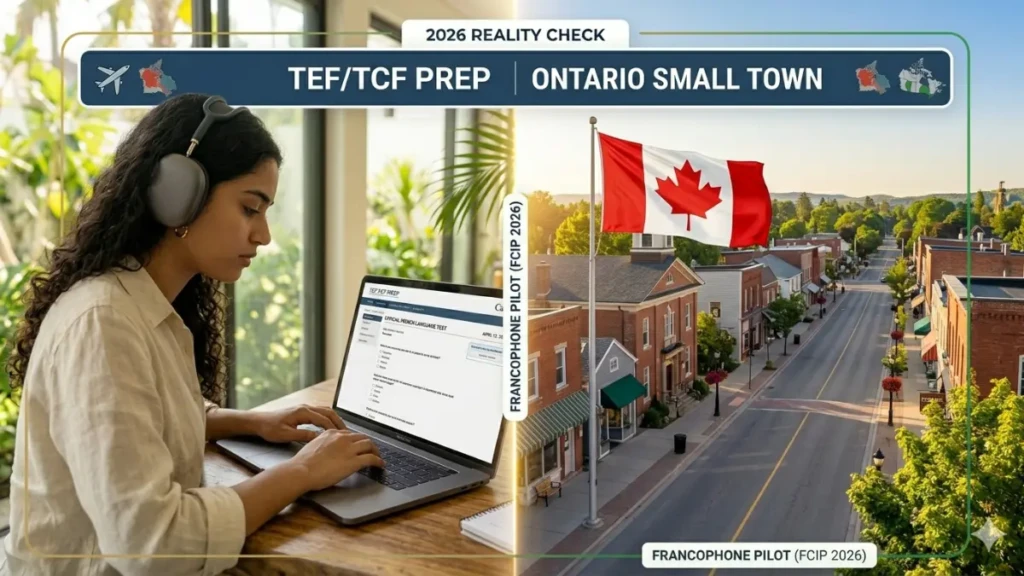
Immigration, Refugees and Citizenship Canada (IRCC) has mandated that 9% of all permanent resident admissions outside of Quebec must be French-speaking in 2026 (scaling up to 10.5% by 2027). To hit these aggressive targets, the IRCC is running massive “Category-Based” draws exclusively for Francophones, ignoring the 500+ standard cutoffs.
If you want to dramatically boost your CRS score and secure an Invitation to Apply (ITA) this year, taking the TEF or TCF Canada is the highest-ROI investment you can make. Here is the exact mathematical breakdown of how French proficiency hacks the Express Entry system.
Table of Contents
- Interactive Tool: The 2026 Bilingual Bonus Calculator
- The Double Advantage: Bonus Points + Category Draws
- The Magic Number: Achieving NCLC 7
- TEF Canada vs. TCF Canada: Which is Easier?
- The 8-Month ROI for Digital Professionals
- Expert Insight: The Value of Language vs. Degrees
- Frequently Asked Questions (FAQ)
Interactive Tool: The 2026 Bilingual Bonus Calculator
Learning French doesn’t just add core language points; it triggers a massive “bilingual bonus.” Use this tool to calculate exactly how many extra CRS points you will earn based on your current English proficiency.Show me the visualization
The Double Advantage: Bonus Points + Category Draws

Most candidates think learning French just adds a few points to their profile. In reality, it provides a twofold systemic advantage:
- The 50-Point Bonus: If you score CLB 5 or higher on your English test (which is very achievable) and NCLC 7 on your French test, the IRCC automatically injects 50 bonus points into your profile. For many candidates stuck at 450, this immediately pushes them to the elite 500 level.
- Category-Based Selection: Even if those 50 bonus points don’t push you past the general draw cutoff, it doesn’t matter. French is the only language-based priority category in 2026. On March 18, 2026, the IRCC invited 4,000 Francophone candidates with a jaw-dropping CRS cutoff of just 393. While English-only candidates needed a 507, French speakers bypassed the line entirely with a score over 100 points lower.
The Magic Number: Achieving NCLC 7
You do not need to be flawlessly fluent or have a perfect Parisian accent to claim these benefits. The IRCC specifically requires a score of NCLC 7 (Niveaux de compétence linguistique canadiens) across all four language abilities: Reading, Writing, Listening, and Speaking.
NCLC 7 equates to an upper-intermediate (B2) level on the European CEFR scale. It means you can comfortably hold a workplace conversation, write a professional email, and understand standard news broadcasts.
TEF Canada vs. TCF Canada: Which is Easier?

To prove your NCLC 7, you must take one of two IRCC-approved tests: the Test d’évaluation de français (TEF Canada) or the Test de connaissance du français (TCF Canada).
- The TEF Canada: Known for being slightly more structured. The reading and listening sections deduct points for incorrect answers (negative marking), meaning you cannot simply guess blindly. However, many candidates find the writing prompts more predictable and business-focused.
- The TCF Canada: There is no negative marking on the multiple-choice sections. However, the speaking and writing sections are often viewed as slightly more abstract, requiring you to express complex opinions rather than just reporting facts.
Pro-Tip: Take a free practice test for both online. Whichever format makes you feel less anxious is the one you should book.
The 8-Month ROI for Digital Professionals
If you are managing client retainers or working remotely, finding time to study is incredibly difficult. But mathematically, studying French for 8 to 10 months has a vastly higher ROI than any other immigration strategy.
Consider this: Going back to a university in your home country to turn your Bachelor’s degree into a Master’s degree will take 2 years, cost thousands of dollars, and only yield about 39 extra CRS points. Conversely, dedicating 10 hours a week to intensive French tutoring for 8 months can yield up to 74 total points (Core language + 50 Bilingual Bonus) and qualify you for the sub-400 category draws.
Expert Insight: The Value of Language vs. Degrees
We spoke with Marc Dubois, a Montreal-based immigration attorney specializing in economic mobility.
“I see highly skilled tech workers desperately trying to get approved for an LMIA work permit just to secure 50 points for a valid job offer. The reality of the 2026 labor market is that LMIAs are increasingly rare and heavily audited. Meanwhile, achieving NCLC 7 in French guarantees you those exact same 50 points, independent of any employer. Furthermore, candidates who show up in Canada already possessing B2 French are being aggressively headhunted by provincial governments in Ontario and New Brunswick.”
Frequently Asked Questions (FAQ)

Do I have to move to Quebec if I use French points?
No. In fact, the Express Entry system is specifically designed for immigration outside of Quebec. To use these points, you must declare your intent to live in any province other than Quebec (such as Ontario, British Columbia, or Alberta). Quebec has its own entirely separate immigration system.
How long are my TEF or TCF results valid?
Your language test results are valid for exactly two years from the date the results were issued. If your results expire while you are sitting in the Express Entry pool, your CRS score will automatically drop, and you will lose your Francophone category eligibility.
Can I claim points if I only get NCLC 7 in three out of four abilities?
No. The Express Entry system is ruthless regarding the NCLC 7 threshold. If you score NCLC 8 in Reading, Writing, and Speaking, but drop to NCLC 6 in Listening, you forfeit the entire 50-point bilingual bonus and your eligibility for the category-based draws. You must hit a minimum of 7 across the board.
Ready to Bypass the Queue?
The days of securing Canadian permanent residency with just a Bachelor’s degree and decent English are largely behind us. But by treating French acquisition as a strategic project rather than just a hobby, you can legally manipulate the CRS system in your favor. Book your TEF or TCF exam, start your daily immersion, and target that magic 393 cutoff.
If you are currently optimizing your financial profile before your move, read our guide on [Building Credit from Scratch: A Step-by-Step Guide for New Immigrants in Canada and the USA].
For the exact NCLC equivalency charts, always refer directly to the [External Link: IRCC Language Requirements Guide].


RCIP Canada 2026: Process, Requirements & Work Permits
12th Apr 2026[…] Boosting Your CRS Score with French Language Testing in 2026 […]