

 English




























How to Claim Home Office Tax Deductions in the US & Canada (2026)

The shift to remote work changed everything about how we live, but the tax codes in the United States and Canada are still playing catch-up. If you spend 40 hours a week working from your dining room table, paying for your own high-speed internet and electricity, it feels obvious that you should get a tax break.
Unfortunately, tax agencies don’t run on “obvious.”
When it comes to home office tax deductions, the rules are notoriously strict, and what is completely legal in the US might trigger an audit in Canada. In 2026, the landscape has shifted again. Canada has permanently retired its easy “pandemic flat rate,” and the US is still enforcing strict divides between freelancers and traditional employees.
Whether you answer to the IRS or the CRA, keeping your hard-earned money means playing strictly by the rules. Let’s break down exactly who qualifies, how to calculate your space, and a definitive checklist of what you can actually write off this tax season.
Table of Contents
- The Golden Rule of the Home Office
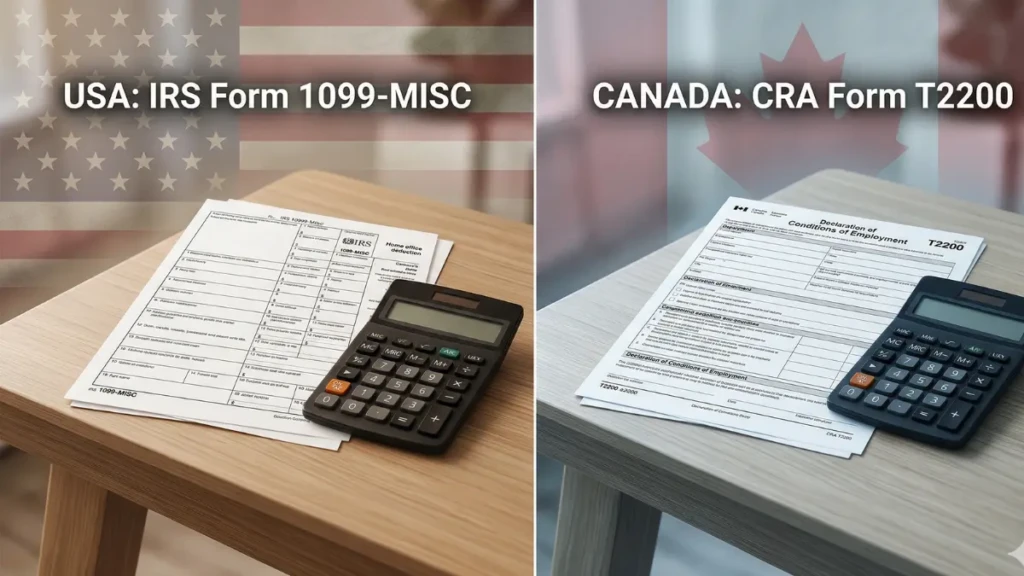
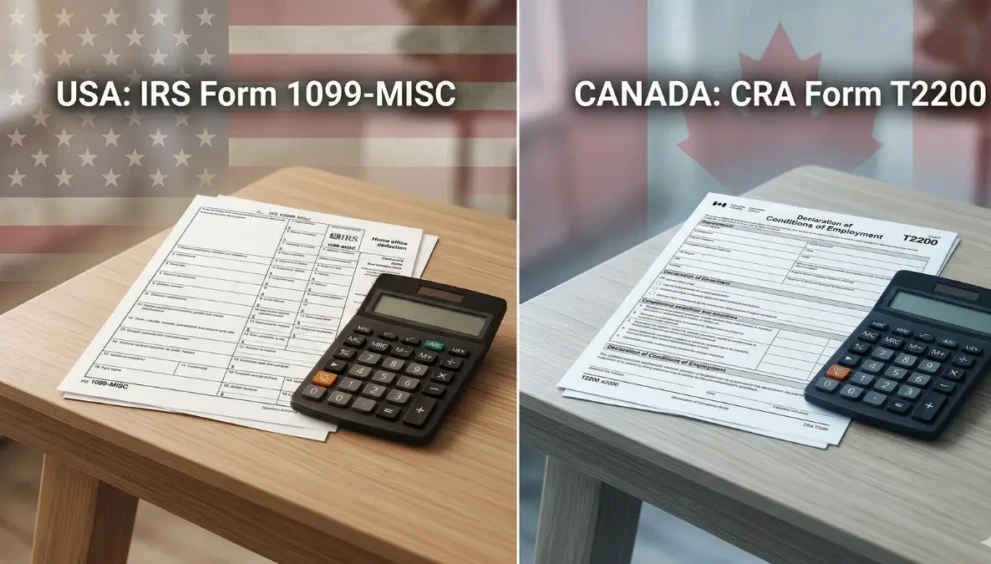
- US Rules (IRS): The 1099 vs. W-2 Divide
- Canadian Rules (CRA): The T2200 Mandate
- The Master Checklist: What Qualifies (And What Doesn’t)
- How to Calculate Your Square Footage Percentage
- Expert Insight: The Red Flags That Trigger Audits
- Frequently Asked Questions (FAQ)
The Golden Rule of the Home Office
Before you start hunting for receipts, you need to pass the foundational test for your respective country. If you fail this step, you cannot claim anything.
- In the US (IRS): The “Exclusive Use” Rule. Your home office must be used exclusively and regularly for business. If your office is also your guest bedroom, or your desk is in the kitchen where you eat dinner, it does not qualify. It must be a clearly defined space used only for work.
- In Canada (CRA): The “Mainly” Rule. The CRA is slightly more forgiving on exclusivity but strict on time. You must have worked from your home workspace more than 50% of the time for a period of at least four consecutive weeks in the year.
US Rules (IRS): The 1099 vs. W-2 Divide
The United States has a massive, glaring division in its tax code regarding who is allowed to claim remote work expenses.
If you are a W-2 Employee:
You are out of luck. Under the current tax laws, standard W-2 employees cannot claim the home office deduction, even if your employer forces you to work from home 100% of the time.
If you are Self-Employed (1099, Freelancer, Small Business Owner):
You are fully eligible. If you file a Schedule C, you have two ways to claim your deduction:
- The Simplified Method: You claim a flat rate of $5 per square foot of your home office, up to a maximum of 300 square feet. The maximum deduction here is $1,500. It requires zero math and zero receipts.
- The Actual Expenses Method: You calculate the exact percentage of your home used for business and deduct that percentage from your rent, mortgage interest, utilities, and insurance.
Need help optimizing your freelance taxes? Review our guide on [Tax Strategies for US Digital Nomads and Freelancers in 2026].
Canadian Rules (CRA): The T2200 Mandate
In Canada, salaried (T4) employees absolutely can claim home office expenses, but the CRA makes you work for it.
During the pandemic, the CRA introduced a “temporary flat-rate method” where you could just claim $2 a day. That program is dead. In 2026, every Canadian claiming home office expenses must use the “Detailed Method.”
The T2200 Requirement:
To claim your expenses on Form T777, you must obtain a signed Form T2200 (Declaration of Conditions of Employment) from your employer. This form legally verifies that you were required to work from home and were required to pay for your own expenses. If you do not have a signed T2200 in your filing cabinet, do not claim the deduction.
The Master Checklist: What Qualifies (And What Doesn’t)
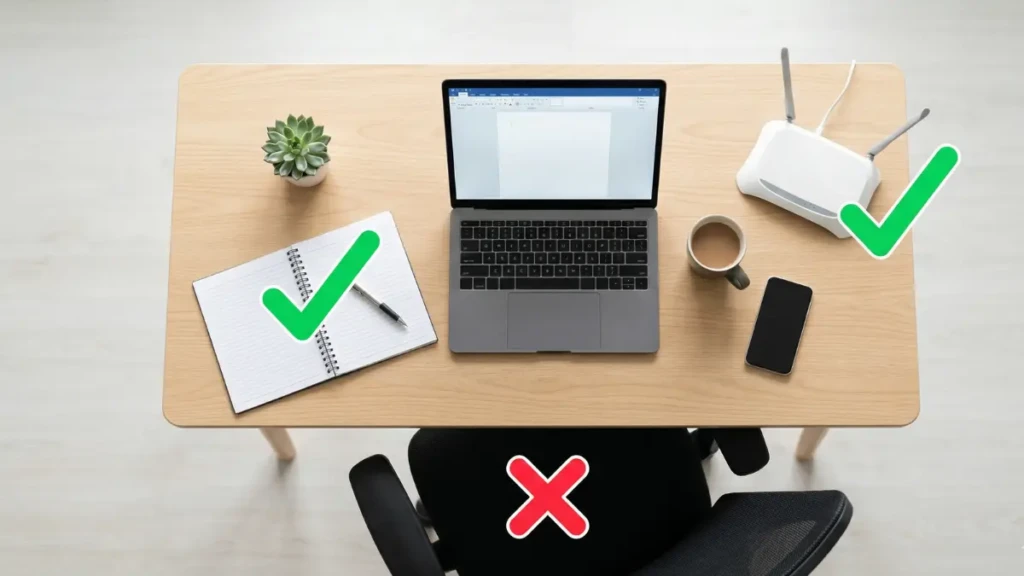
This is where the confusion happens. Just because it is in your office does not mean it is a write-off. Here is the definitive cross-border comparison.
| Expense Type | IRS (Self-Employed USA) | CRA (Salaried Canada) |
| Home Internet | ✅ Yes (Business % only) | ✅ Yes (Employment % only) |
| Rent Payments | ✅ Yes (Business % only) | ✅ Yes (Employment % only) |
| Utilities (Hydro, Gas) | ✅ Yes (Business % only) | ✅ Yes (Employment % only) |
| Mortgage Interest | ✅ Yes (Business % only) | ❌ No |
| Mortgage Principal | ❌ No | ❌ No |
| Property Taxes & Insurance | ✅ Yes (Business % only) | ❌ No (Unless commissioned) |
| Office Furniture (Desk/Chair) | ✅ Yes (Depreciated or Section 179) | ❌ No (Capital expense) |
| Laptops & Monitors | ✅ Yes (Depreciated or Section 179) | ❌ No (Capital expense) |
| Office Supplies (Pens/Paper) | ✅ Yes (100% deductible) | ✅ Yes (100% deductible) |
The Furniture Trap: Notice the glaring difference. In the US, a freelancer can write off a $1,000 ergonomic Herman Miller chair as a business expense. In Canada, employees cannot claim chairs, desks, or monitors. The CRA views these as “capital expenses,” which are strictly forbidden for salaried employees.
How to Calculate Your Square Footage Percentage

If you are using the actual/detailed method in either country, you cannot just guess your expenses. You must calculate your home’s “business-use percentage.”
The Formula:
(Square Footage of Office ÷ Total Square Footage of Home) x 100 = Business Percentage
Example:
- Your home is 1,000 square feet.
- Your dedicated home office is 150 square feet.
- (150 ÷ 1000) x 100 = 15%
If your monthly home internet bill is $100 ($1,200/year), you can legally deduct $180 (15% of $1,200) as a home office expense.
Expert Insight: The Red Flags That Trigger Audits
We asked a cross-border CPA what mistakes trigger an audit from the IRS or the CRA when claiming remote work deductions.
“The number one red flag is claiming a 100% deduction on a dual-purpose utility, like a cell phone or home internet. Neither the IRS nor the CRA believes you use your home internet strictly 100% for work and never stream Netflix or browse social media. Always apply your calculated business-use percentage to these bills. Overreaching on internet costs is the fastest way to get your entire return flagged for a manual review.”
Frequently Asked Questions (FAQ)
Can I claim a home office if I rent an apartment?
Yes. In both the US (for 1099 workers) and Canada (for eligible employees), rent is one of the most valuable deductions you can claim. You apply your business-use percentage to your total yearly rent paid.
Do I need to keep my internet and utility receipts?
Absolutely. If you are using the detailed/actual expenses method, both the IRS and CRA require you to keep your supporting documents (bills, receipts, and the T2200 for Canadians) for up to six years in case of an audit.
Is it worth the hassle to claim home office deductions?
Yes. If you pay $2,000 a month in rent and use 15% of your apartment for an office, that is a $3,600 deduction right off the top of your taxable income. Depending on your tax bracket, that could translate to hundreds of dollars in real cash returned to your pocket.
What if I worked from a coffee shop or a co-working space?
For US freelancers, co-working space fees are a separate, fully deductible business expense (not a “home office” expense). For Canadian employees, you cannot claim coffee shop expenses (like food or drinks), but you may be able to claim a portion of co-working fees if your employer explicitly requires you to rent an outside space and notes it on your T2200.
Maximize Your Return
Don’t let government tax agencies keep money that legally belongs to you. By understanding your employment status, tracking your utility percentages, and keeping a firm line between what is a valid expense (rent) and what isn’t (that new expensive desk), you can safely maximize your refund.
For official forms and detailed tax publications, always verify with the [ IRS Official Home Office Guide] if you are in the US, or the [ CRA Work Space in the Home Guide] if you are in Canada.
Looking to optimize the rest of your remote work setup? Read our guide on [http://Best No-Annual-Fee Credit Cards of April 2026: Ultimate Guide].