

 English





















The 5 Questions Every Canadian Hiring Manager Will Ask You in 2026


Your resume got you in the door. It proved you have the technical skills, the education, and the background. But in the 2026 Canadian job market, the resume is just the ticket to the dance. The interview is where the actual hiring decision is made, and Canadian hiring managers are looking for something very specific: Cultural Fit and Adaptability.
If you are a newcomer to Canada, or simply re-entering the job market after a few years, the interview landscape has shifted. The integration of AI into daily workflows, the normalization of hybrid schedules, and a hyper-focus on collaborative “soft skills” have fundamentally changed the questions you will face.
Canadian employers generally avoid aggressive, high-pressure interrogation tactics. Instead, they rely heavily on Behavioral Interviewing—asking about your past behavior to predict your future performance.
If you want to ace your next meeting, you need to prepare for these exact five Canadian job interview questions in 2026, along with the psychological reasoning behind why they are asking them.
Table of Contents
- The STAR Method: Your Interview Superpower
- Question 1: The Tech & Adaptability Test
- Question 2: The Canadian Cultural Conflict
- Question 3: The Hybrid Work Reality
- Question 4: The Accountability Anchor
- Question 5: The “Unlearning” Question
- Expert Insight: The Final Trap
- Frequently Asked Questions (FAQ)
The STAR Method: Your Interview Superpower
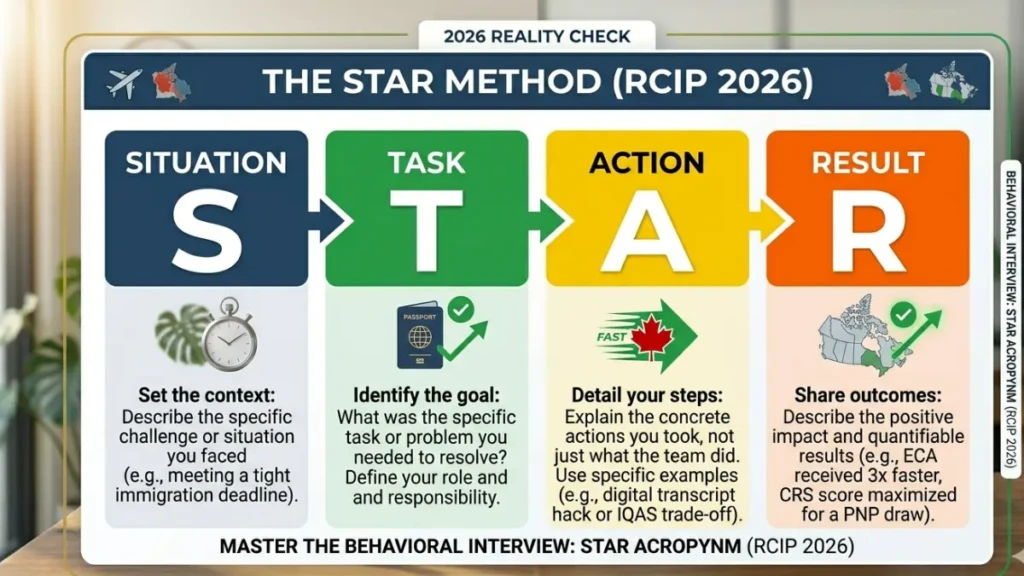
Before looking at the questions, you must learn the formula for answering them. When a Canadian hiring manager asks a behavioral question (anything starting with “Tell me about a time…”), they expect a structured story.
If you ramble, you lose them. Use the STAR method:
- S (Situation): Set the scene briefly. (e.g., “We were two days away from a major product launch…”)
- T (Task): What was your specific responsibility? (“…and my job was to finalize the client presentation.”)
- A (Action): What specific steps did you take? Use “I”, not “We”. (“I stayed late, reorganized the data using a new software tool, and…”)
- R (Result): What was the positive business outcome? Use numbers if possible. (“…resulting in a successful pitch and a $50,000 contract.”)
Question 1: “Tell me about a time you had to adapt to a sudden change in technology or workflow.”
Why they are asking: This is the 2026 update to the classic adaptability question. With companies rapidly adopting new AI tools, automated CRMs, and shifting software stacks, employers are terrified of hiring someone who is rigid or resistant to change.
How to answer it: Do not say, “I am a fast learner.” Prove it with a STAR story. Talk about a time a previous employer introduced a new system (even something as simple as moving from Excel to a specialized database) that disrupted your routine.
- The winning angle: Focus on your attitude. Highlight that you didn’t just learn the new tool, but you helped a struggling colleague learn it, too. Canadian managers love team players.
Question 2: “How do you handle disagreements or pushback from a colleague?”
Why they are asking: This is the ultimate test of Canadian workplace culture. In some global corporate cultures, aggressive debate and blunt criticism are rewarded as signs of leadership. In Canada, that approach will almost always get you labeled as “difficult to work with.” Canadian culture highly values politeness, consensus-building, and constructive feedback.
How to answer it: Your story needs to demonstrate active listening and compromise.
- The winning angle: Describe a situation where you strongly disagreed with a coworker’s plan. Explain how you scheduled a private 1-on-1 meeting, listened to their perspective without interrupting, and found a middle ground that integrated both of your ideas to benefit the project.
Question 3: “How do you maintain productivity and communication when working in a hybrid or remote setting?”

Why they are asking: The hybrid model (3 days in the office, 2 days at home) is the standard in 2026. Managers want to know they don’t have to micromanage you when you are out of sight. They are looking for self-starters who proactively communicate.
How to answer it: Focus on structure and visibility.
- The winning angle: Explain your home-office routine. Mention the specific tools you use to stay organized (like Trello, Asana, or simple time-blocking). More importantly, emphasize how you “manage up”—for example, sending your boss a brief end-of-week summary email on Fridays so they always know what you accomplished while working remotely.
Question 4: “Tell me about a time you failed or missed a deadline. What happened?”
Why they are asking: Nobody is perfect. Hiring managers ask this to test your self-awareness and accountability. If you say, “I’ve never missed a deadline,” they will immediately assume you are lying or lack self-awareness. If you blame your previous boss or coworkers, you will fail the interview instantly.
How to answer it: Pick a genuine, but recoverable, mistake from your past.
- The winning angle: Own the mistake completely. “I underestimated how long the data analysis would take, and I missed the Friday deadline.” Then, pivot immediately to the solution. “I immediately notified my manager, worked a few hours on Saturday to finish it, and subsequently created a buffer-system in my calendar so I never under-projected a timeline again.”
Question 5: “What is a skill you are currently trying to unlearn or improve?”
Why they are asking: The standard “What is your biggest weakness?” question is dead. Candidates rehearsed fake answers like “I work too hard.” In 2026, managers ask about unlearning to see if you possess a growth mindset.
How to answer it: Be honest about a professional habit you are actively working to upgrade.
- The winning angle: Make it actionable. “I used to rely heavily on manual data entry because I trusted my own eyes. However, I’m currently trying to unlearn that habit by taking a course on Python automation, which is teaching me to trust the software and free up my time for higher-level strategy.”
Expert Insight: The Final Trap
We asked Sarah Jenkins, a Senior HR Director in Toronto, what the biggest interview mistake of 2026 is.
“The interview isn’t over until you log off the video call or walk out the door. When I ask, ‘Do you have any questions for me?’, if the candidate says ‘No, I think you covered everything,’ I usually pass on them. A lack of questions shows a lack of genuine curiosity about the role. Always have two prepared questions. Ask me what the biggest challenge the team is facing right now, or ask me what success looks like in the first 90 days of the job. Interviewing is a two-way street.”
Frequently Asked Questions (FAQ)
What should I wear to a Canadian job interview in 2026?
The post-pandemic dress code leans toward “Business Casual,” but you should always dress one step above the company’s daily attire. If they wear jeans and t-shirts, wear crisp chinos and a button-down shirt or blouse. If it is a bank or law firm, a full suit is still required. When in doubt, it is always better to be slightly overdressed than underdressed.
Should I bring a physical copy of my resume to an in-person interview?
Yes. Even in our highly digital 2026 workplace, bringing three clean, printed copies of your resume in a professional folder shows outstanding preparation. Sometimes a hiring manager’s tablet dies or they couldn’t print it in time; handing them a fresh copy makes you look incredibly reliable.
How do I answer ‘Tell me about yourself’ in Canada?
Do not recite your entire life story or read your resume line-by-line. Use the “Present-Past-Future” formula. Start with your current role and a major achievement. Briefly touch on past experience that led you here. Finish with why you are excited about the future and this specific job opportunity. Keep it under two minutes.
Is it okay to ask about salary during the first interview?
Generally, no. In Canadian corporate culture, it is considered taboo for the candidate to bring up salary, benefits, or vacation time during the first interview. Focus on the value you bring to the company. Wait for the recruiter or hiring manager to bring up compensation, which usually happens during the initial phone screen or the final offer stage.
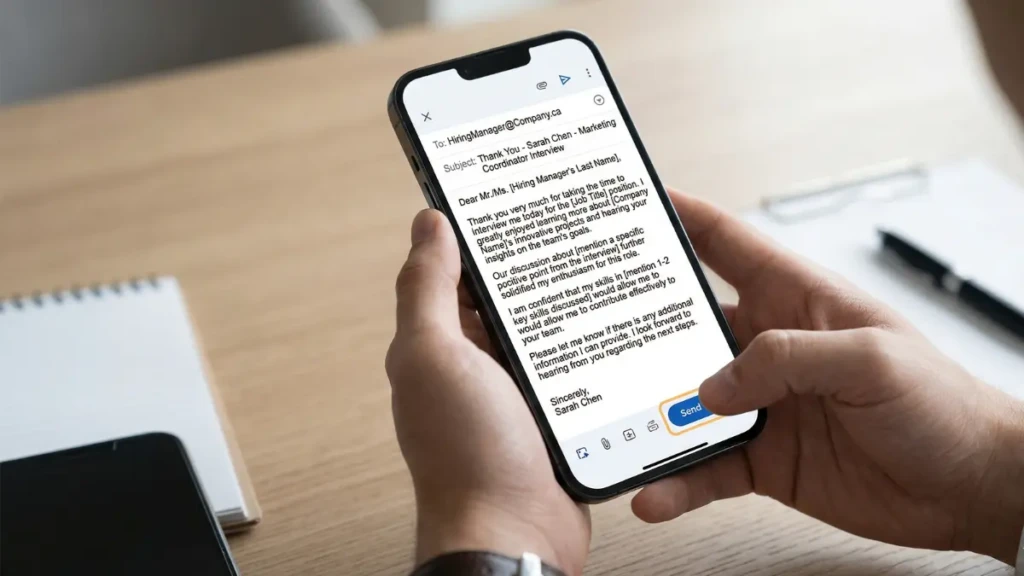
How quickly should I send a thank-you email? You should send a short, personalized thank-you email to every person who interviewed you within 24 hours of the interview. Reiterate your enthusiasm for the role and briefly mention one specific thing you discussed to show you were actively listening.
Step Into the Room with Confidence
Navigating behavioral interview questions in Canada is a skill, and like any skill, it requires practice. Do not memorize your answers word-for-word, but absolutely memorize your STAR stories. Outline three major professional successes and two recoverable failures. When the hiring manager asks the question, simply pull the right story from your mental filing cabinet, speak clearly, and show them you are ready to build the future of their company.
Need to make sure your resume actually gets you to the interview stage? Read our comprehensive guide on [How to Write a Canadian-Style Resume That Beats the ATS].
For more insights into the current employment landscape, review the latest reports on [ The Government of Canada Job Bank Trends].

How to Get a Job Offer for the RCIP in Canada (2026 Strategy)
12th Apr 2026[…] The 5 Questions Every Canadian Hiring Manager Will Ask You […]