
 English













TSA vs CATSA Liquid Rules 2026: Carry-On Packing Guide

It is 11:00 PM the night before your flight. Your carry-on is open on the bed, and you are staring at a half-used bottle of expensive moisturizer, wondering if it will survive the security checkpoint tomorrow morning.
If you travel frequently between the United States and Canada, you know the drill. However, assuming that American and Canadian airport security operate under the exact same regulations is a fast way to get your favorite toiletries thrown in the trash.
Understanding the nuance between TSA vs CATSA liquid rules is essential for a frictionless travel day. While the baseline metrics look similar, the strictness of enforcement, the exceptions for medical items, and the 2026 rollout of new CT scanners mean you need to pack strategically.
This ultimate guide breaks down exactly what you can pack, what must be checked, and the secret “solid swap” strategies experts use to bypass the liquid limits entirely.
Table of Contents
- The Baseline: Are TSA and CATSA Rules the Same?
- The 2026 Game Changer: CT Scanners
- What Actually Counts as a “Liquid”?
- Carry-On Tables: What to Pack vs. What to Check
- Major Exceptions: Medications, Baby Food, & Duty-Free
- Expert Insight: The “Solid Swap” Strategy
- Frequently Asked Questions (FAQ)
The Baseline: Are TSA and CATSA Rules the Same?
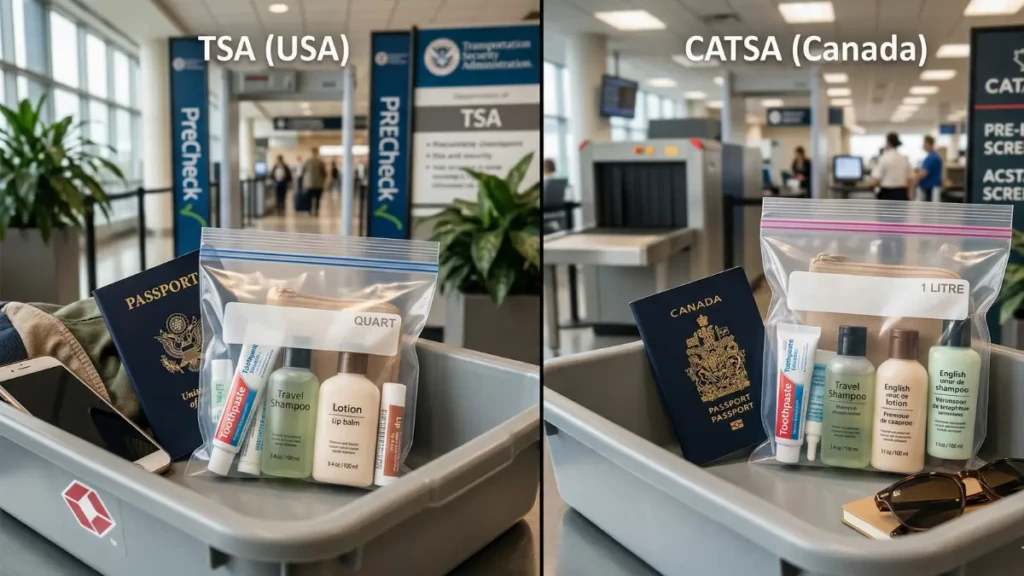
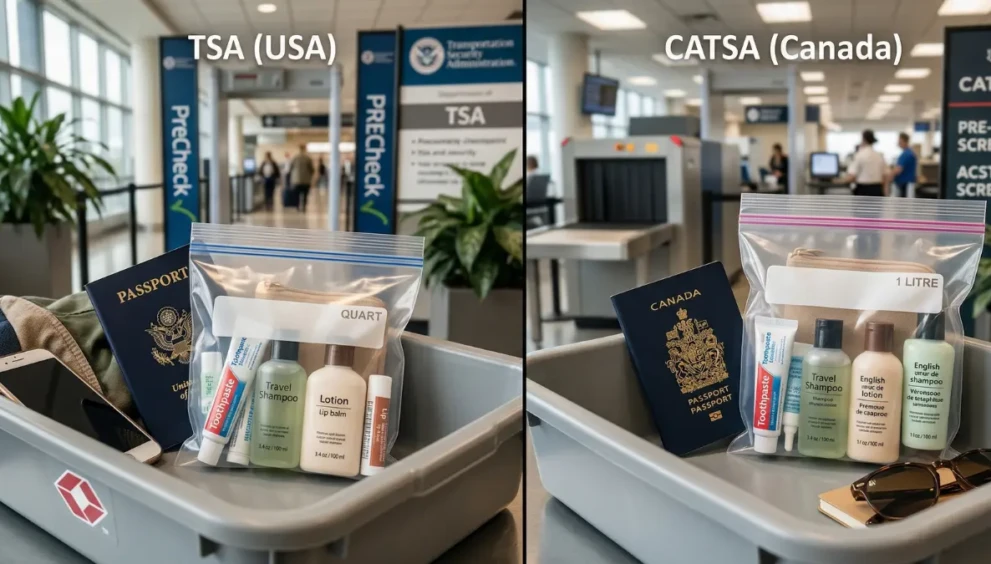
At their core, the United States Transportation Security Administration (TSA) and the Canadian Air Transport Security Authority (CATSA) share a unified goal: preventing dangerous liquid volumes from entering an aircraft cabin. Because both agencies collaborate closely, their baseline rules are incredibly similar, but the terminology differs.
The US Standard: The TSA 3-1-1 Rule
In the United States, the policy is famously branded as the 3-1-1 Rule.
- 3.4 Ounces: Every individual container must hold 3.4 ounces (100 ml) or less.
- 1 Quart Bag: All containers must fit inside one clear, quart-sized, resealable plastic bag.
- 1 Passenger: Each traveler is limited to one bag.
The Canadian Standard: The CATSA 100ml / 1-Litre Rule
Canada does not use the “3-1-1” catchy branding, but the mathematics are effectively identical.
- 100 Millilitres: No single container can exceed 100 ml (which equates to 3.4 oz).
- 1 Litre Bag: All liquids must fit into a single clear, resealable plastic bag with a maximum capacity of 1 litre.
- 1 Passenger: You get one bag per person.
Common Mistake: Both TSA and CATSA enforce the container size, not the contents. A 200 ml tube of toothpaste that is 90% empty will be confiscated at both US and Canadian checkpoints because the vessel itself violates the limit.
The 2026 Game Changer: CT Scanners
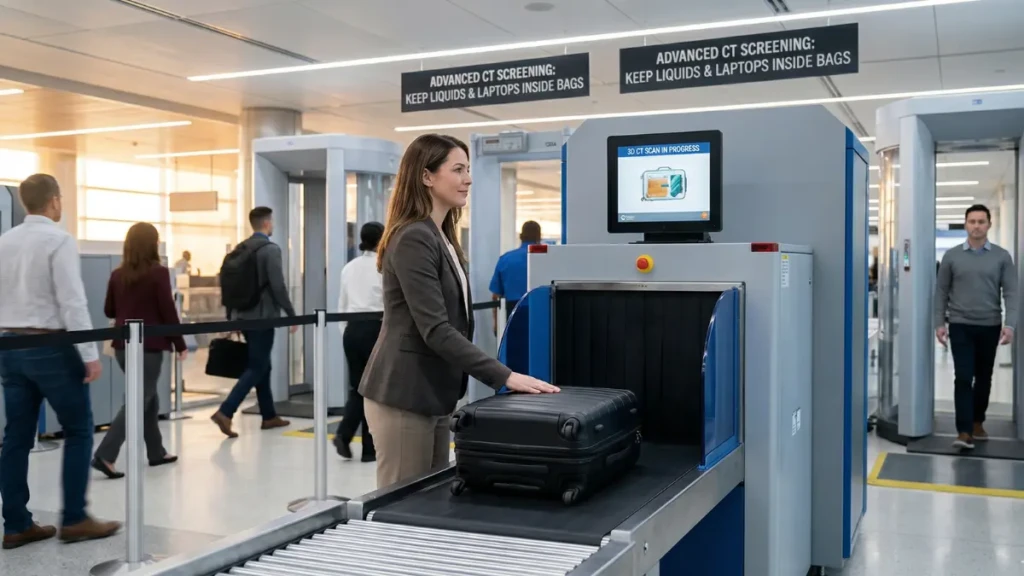
If you have traveled recently, you may have noticed massive new, hospital-like machines replacing the old X-ray belts. These are Computed Tomography (CT) scanners, and they are changing the airport security experience across North America in 2026.
However, they are causing massive confusion regarding liquid limits.
Here is the 2026 reality for both TSA and CATSA:
The new CT scanners use advanced 3D imaging to detect threats with incredible accuracy. Because of this, if you are directed to a lane with a CT scanner, you do not need to take your liquids bag out of your carry-on. However, the volume limits have not changed. Even with advanced scanners, your liquids must still be 100 ml / 3.4 oz or smaller. Do not assume that a fancy new machine means you can bring a full-sized bottle of shampoo. Until a nationwide policy change is officially announced by the governments, the 100 ml limit remains the absolute law of the land.
Not sure if your suitcase qualifies as a carry-on? Review our comprehensive [Internal Link: 2026 Airline Carry-On Luggage Size Guide] before you pack.
What Actually Counts as a “Liquid”?
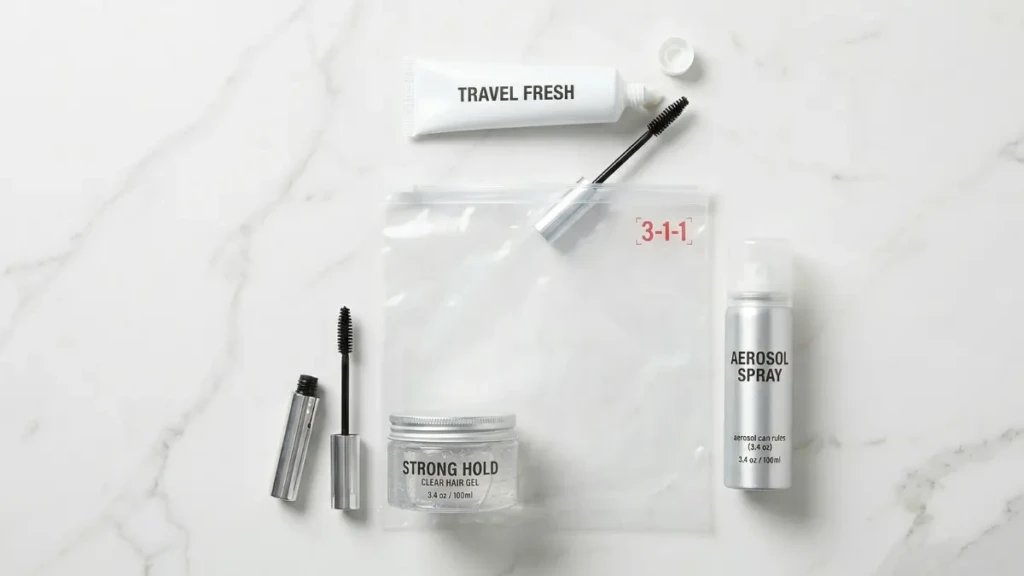
This is where 90% of confiscations happen. Travelers often forget that airport security defines “liquids” much more broadly than we do in daily life.
Both TSA and CATSA adhere to what security experts call the “Spreadable Rule.” If a substance can be poured, pumped, squeezed, or spread, it is a liquid. If it does not maintain a completely solid shape at room temperature, it must go in your clear plastic bag.
Sneaky items that count as liquids:
- Peanut butter and jam
- Gel deodorants (Stick deodorants are solid; gels are liquids)
- Hair pomade and styling pastes
- Mascara and lip gloss
- Soft cheeses (like Brie or Camembert)
- Aerosol sprays (hairspray, dry shampoo)
Carry-On Tables: What to Pack vs. What to Check
To eliminate the guesswork, use these reference tables when packing your carry-on luggage for US or Canadian flights.
✅ The Green Light: Allowed in Carry-On (Must fit in your 1L / Quart bag)
| Item Type | TSA Rules (USA) | CATSA Rules (Canada) |
| Shampoo / Body Wash | Max 3.4 oz (100 ml) | Max 100 ml |
| Toothpaste | Max 3.4 oz (100 ml) | Max 100 ml |
| Mascara / Liquid Makeup | Max 3.4 oz (100 ml) | Max 100 ml |
| Aerosol Deodorant | Max 3.4 oz (100 ml) | Max 100 ml |
| Hand Sanitizer | Max 3.4 oz (100 ml) | Max 100 ml |
❌ The Red Light: Must Go in Checked Baggage
| Item Type | Why it Fails Security |
| Full-Sized Sunscreen (over 100 ml) | Exceeds the volume limit. |
| Bottles of Wine / Liquor | Exceeds volume limits (and requires checked baggage declaration). |
| Large Jars of Peanut Butter | Considered a paste/gel; exceeds 100 ml. |
| Snow Globes | The liquid inside is almost always over 3.4 oz. |
| Partially Empty 200 ml Bottles | Container size dictates the rule, not the remaining liquid. |
Major Exceptions: Medications, Baby Food, & Duty-Free
Security rules are strict, but they are not inhumane. Both TSA and CATSA offer identical exemptions for essential life items.
1. Medical Liquids
You are permitted to bring prescription liquids, over-the-counter liquid medications (like cough syrup), and contact lens solution in quantities greater than 100 ml.
- The Catch: You must declare these items to the security officer before your bag goes through the X-ray. They will be subjected to additional screening.
2. Baby Formula and Breast Milk
Traveling with infants is stressful enough. Formula, breast milk, toddler drinks, and baby food purées are exempt from the 3.4 oz / 100 ml rule. You are allowed to carry them in “reasonable quantities” for the duration of your itinerary. Ice packs used to keep these items cold are also permitted.
3. International Duty-Free
If you purchase a massive bottle of duty-free alcohol or perfume in Europe and are connecting through Toronto or New York, you can bring it through security.
- The Catch: It must be sealed in a secure, tamper-evident bag (STEB) provided by the duty-free shop, and you must have the receipt proving the purchase was made within the last 48 hours. If you open the bag before your final destination, the liquid will be confiscated.
If you are traveling with extensive beauty routines, read our specific breakdown on [Internal Link: Flying With Makeup: Packing Hacks for Beauty Enthusiasts].
Expert Insight: The “Solid Swap” Strategy
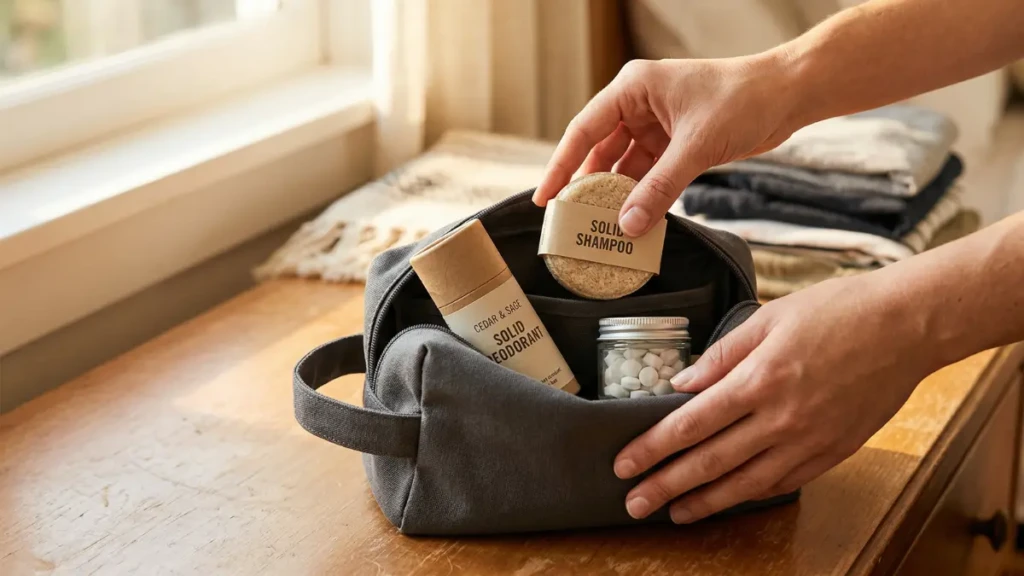
We spoke with frequent cross-border business traveler and packing consultant, Elena Rostova, to find out how pros handle the TSA vs CATSA liquid rules.
“The secret to stress-free airport security in 2026 isn’t buying a better clear plastic bag; it is systematically removing liquids from your routine. I call it the ‘Solid Swap.’ Swap liquid shampoo for a shampoo bar. Swap liquid foundation for a stick foundation. Swap gel deodorant for a solid stick. Swap standard toothpaste for chewable toothpaste tablets. By converting 80% of your toiletries to solids, you never have to worry about the 100ml limit, and you completely eliminate the risk of a bottle exploding on your clothes mid-flight.”
Frequently Asked Questions (FAQ)
Is a stick deodorant considered a liquid by TSA or CATSA?
No. Solid stick deodorants and solid powders are not considered liquids. You can pack a full-sized solid deodorant in your carry-on without placing it in your clear plastic bag. However, roll-on, gel, and aerosol deodorants are considered liquids.
Do I have to take my liquids out of my bag in 2026?
It depends entirely on the machine at your specific security lane. If you are directed to a newer CT scanner (the large, rounded machines), you can leave your liquids and laptops in your bag. If you are at a standard X-ray machine, you must take the clear bag out. Always listen to the local officers.
What happens if I forget a liquid in my carry-on?
If the X-ray detects an oversized liquid, your bag will be pulled aside for secondary inspection. The officer will find the item and inform you that it cannot fly. You generally have three choices: surrender it (it gets thrown away), go back to the ticketing counter to check the bag, or hand it to a non-traveling friend at the airport.
Can I bring frozen liquids through security?
According to the TSA, if a liquid (like a water bottle) is frozen solid when presented at the security checkpoint, it is allowed through. However, if it is even slightly slushy or melting, it must meet the 3.4 oz liquid requirement. CATSA generally adheres to a similar logic regarding ice packs for coolers, provided they are frozen solid.
Does TSA PreCheck or Nexus change the liquid limits?
No. TSA PreCheck (US) and Nexus/Verified Traveller (Canada) allow you to leave your liquids in your bag during screening, but they do not grant you permission to bring liquids larger than 100 ml / 3.4 oz. The volume limits apply universally to all passengers.
Pack Smart, Travel Faster
The anxiety of the security checkpoint is entirely avoidable. By understanding that TSA vs CATSA liquid rules both enforce a strict 100 ml container limit, utilizing the “Solid Swap” strategy, and keeping your medical exemptions organized, you can walk through security with total confidence. Pack your clear bag the night before, keep it easily accessible, and enjoy the flight.
For real-time updates directly from the authorities, bookmark the [External Link: Official TSA Liquids Rule Page] and the [External Link: CATSA What Can I Bring Tool] before your next cross-border trip.
Related Post: