

 English


























































































4 Things You Should Never Do to Your EV Battery (2026 Guide)

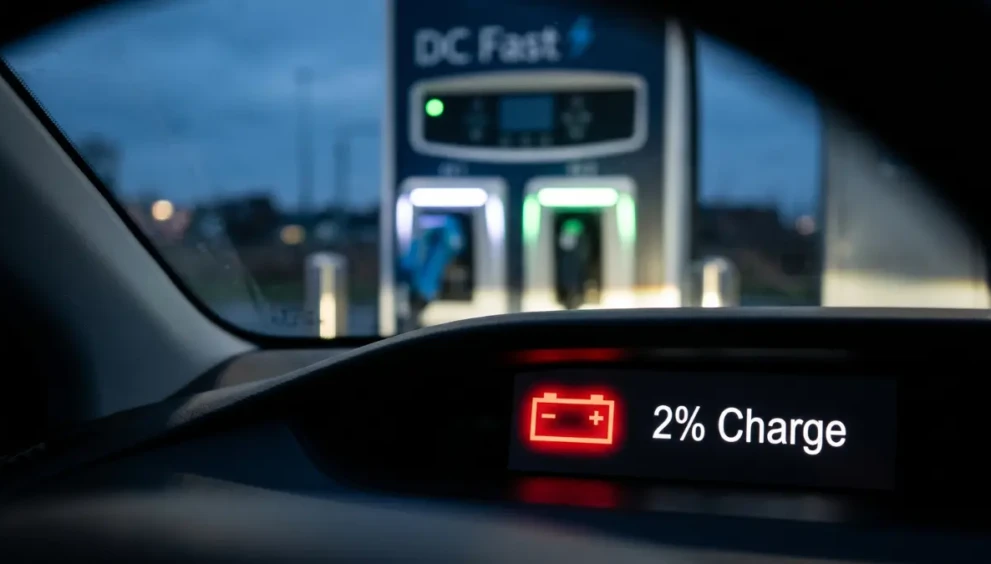
The transition to an Electric Vehicle (EV) fundamentally changes how you think about “fueling” your car. Unlike a gas tank, which is an inert metal box, an EV battery is a living, breathing chemical ecosystem.
In the booming 2026 US and Canadian EV markets, the biggest fear preventing widespread adoption is battery degradation. If you ruin your battery, you are looking at a catastrophic $10,000 to $15,000 replacement bill.
The good news? Modern EV batteries are engineered to outlast the car itself—often rated for 300,000 to 500,000 miles. However, that lifespan is only guaranteed if you follow the rules. Many new owners accidentally accelerate their battery’s death by treating it like an oversized smartphone.
If you want to protect your investment and maximize your range, here are the 4 things you should never do to your EV battery, along with the exact EV battery maintenance protocols you need to follow.
Table of Contents
- The “Always 100%” Trap (Know Your Chemistry)
- The Fast Charger Addiction
- Deep Discharging (The 0% Danger Zone)
- Ignoring Extreme Thermal Exposure
- Expert Insight: The 12-Volt Phantom Death
- Frequently Asked Questions (FAQ)
1. The “Always 100%” Trap (Know Your Chemistry)
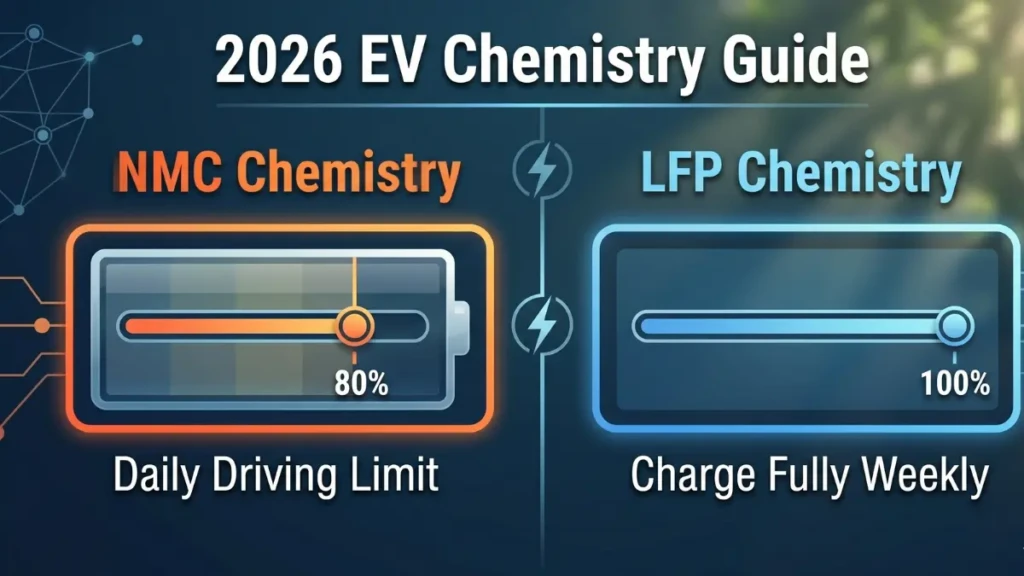
The most heavily debated topic in EV battery maintenance is how full you should charge the car. If you listen to outdated advice, you will ruin your battery. In 2026, the rules depend entirely on the chemistry of your specific battery pack.
You must check your owner’s manual to find out if you have an NMC or an LFP battery.
- NMC (Nickel Manganese Cobalt): Found in long-range and performance EVs. NEVER charge this battery to 100% for daily driving. Holding an NMC battery at maximum voltage stresses the chemical structure, leading to permanent capacity loss. Keep your daily charging limit set to 80%. Only charge to 100% right before a massive road trip.
- LFP (Lithium Iron Phosphate): Found in many standard-range EVs (like the base Tesla Model 3 and Ford Mustang Mach-E). NEVER leave this battery sitting at a low charge indefinitely. In fact, automakers explicitly recommend you charge an LFP battery to 100% at least once a week to calibrate the battery management system and ensure accurate range estimates.
2. The Fast Charger Addiction
DC Fast Chargers (Level 3 chargers like the Tesla Supercharger network or Electrify America) are modern engineering marvels. Pumping hundreds of kilowatts into a battery allows you to cross the country with ease.
However, you should never use them as your primary, daily charging method.
The Danger of Heat:
Pushing massive amounts of electricity into a battery generates extreme heat. While your EV has a liquid cooling system to manage this, relying entirely on DC Fast Charging puts immense, repetitive thermal stress on the battery cells. Over time, this microscopic damage accumulates, permanently reducing your maximum range.
The Fix: For standard EV battery maintenance, rely on Level 1 or Level 2 AC charging (plugging in at home or at work) for 90% of your needs. Treat DC Fast Chargers as a tool strictly reserved for long road trips or emergencies.
3. Deep Discharging (The 0% Danger Zone)
Running a gas car down to the “E” line is a harmless thrill. Running an electric vehicle down to 0% is an act of financial self-sabotage.
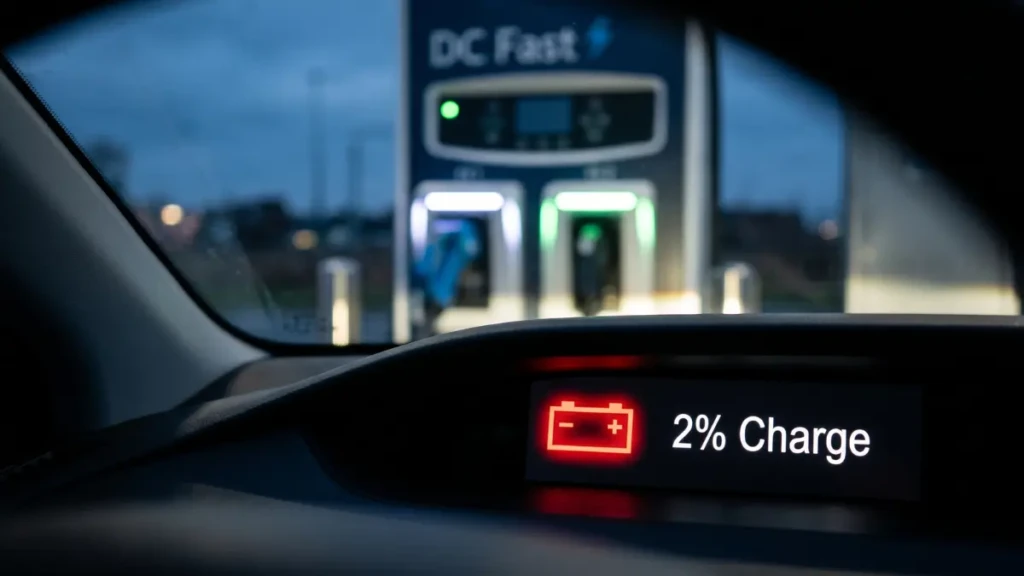
Lithium-ion batteries hate being entirely empty. When the battery’s state of charge drops below 10%, the internal resistance spikes, and the chemical composition becomes highly unstable. If you let an EV hit 0% and leave it parked there for days, the battery cells can actually “brick” (die permanently), requiring a full module replacement that your warranty may not cover due to “owner negligence.”
The Fix:
Treat 20% as your new “Empty.” Plan your charging stops so you rarely drop below the 10-20% threshold.
4. Ignoring Extreme Thermal Exposure
Batteries operate perfectly in the exact same temperatures that humans prefer: roughly 65°F to 75°F (18°C to 24°C).
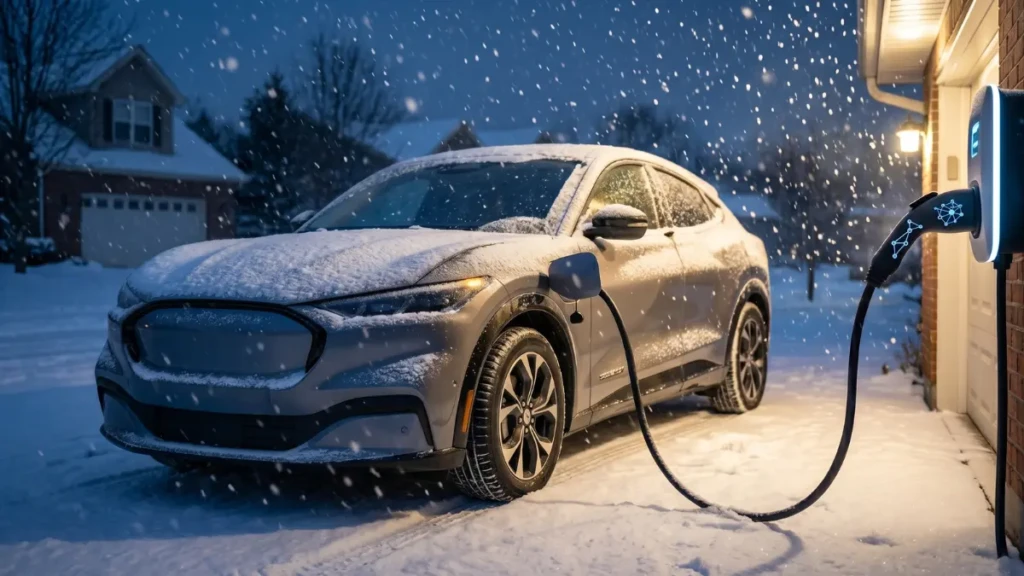
Leaving your EV parked unplugged in a sun-baked Arizona driveway at 110°F, or freezing in a Canadian winter at -10°F, forces the battery to sustain damage.
The Fix:
When dealing with extreme weather, the golden rule of EV battery maintenance is simple: “A plugged-in EV is a happy EV.” When your car is plugged in at home, it uses grid power (rather than its own battery power) to run the internal Thermal Management System. The car will automatically heat or cool the battery pack to keep the cells in a perfect, stable state, completely protecting your range from extreme ambient weather.
Expert Insight: The 12-Volt Phantom Death
We asked an EV service technician what the most common cause of a “dead” electric car actually is.
“People panic when their EV won’t start, assuming the massive $15,000 high-voltage battery died. 99% of the time, that isn’t the case. Every EV still has a standard, cheap 12-volt lead-acid or lithium-ion battery under the hood that runs the computers and the door locks. If that 12-volt battery dies, the car cannot switch on the high-voltage pack. If your EV suddenly goes completely dark and won’t unlock, don’t panic. You likely just need a $150 replacement of the 12-volt accessory battery, just like a gas car.”
Frequently Asked Questions (FAQ)
Is it okay to charge my EV every night?
Yes. In fact, ABC—”Always Be Charging”—is a common mantra among EV owners. Plugging your car in every night (especially to a Level 2 home charger) allows the battery management system to balance the cells and run thermal management using grid power. Just ensure your charge limit is set to the correct percentage for your chemistry (80% for NMC, 100% for LFP).
How much range will my EV lose over 10 years?
In 2026, vast amounts of telematics data show that modern EV batteries are holding up significantly better than early skeptics predicted. The average EV battery degrades at a rate of only 1.5% to 2.0% per year. After a decade of driving, you can expect to retain 80% to 85% of your original range.
Does regenerative braking damage the battery?
No. Regenerative braking (which captures kinetic energy to slow the car down and feed power back into the battery) is entirely safe and heavily managed by the car’s computer to ensure it doesn’t overcharge or overheat the cells.
Protect the Heart of Your Car
You do not need an engineering degree to extend your electric vehicle battery life. By simply understanding your specific cell chemistry, avoiding the temptation of daily fast-charging, and keeping the car plugged in during extreme weather, your battery will easily outlast the chassis of the vehicle.
If you are optimizing your finances to afford a premium EV this year, dive into our guide on [How to Improve Credit Score Fast in 2026 (Step-by-Step Guide)] to ensure you secure the absolute best auto loan rate.