

 English




























































































The “Sunday Reset” Routine That Will Completely Change Your Work Week


By 4:00 PM on a Sunday, a familiar sense of dread begins to creep in. Your weekend is technically still happening, but your brain has already shifted to the looming deadlines, unread emails, and chaotic logistics of Monday morning. This psychological phenomenon is known as the “Sunday Scaries,” and it is the fastest route to chronic burnout.
If you are treating your weekends merely as a time to collapse, you are setting yourself up for a chaotic work week. In the modern, high-pressure economy, your mental bandwidth is your most valuable asset. You cannot afford to wake up on Monday and waste cognitive energy figuring out what to wear, what to eat, or what your top priorities are.
To scale your output and protect your mental health, you must treat your personal life like a predictable system. Enter the Sunday reset routine.
This is not about spending your entire day off doing chores. It is a highly targeted, two-hour psychological productivity trick designed to clear your mental RAM, eliminate decision fatigue, and engineer a zero-friction week. Here is the exact blueprint to execute it.
Table of Contents
- The Psychology: Defeating Decision Fatigue
- Phase 1: The “Zero-Friction” Physical Reset
- Phase 2: The Mental “Brain Dump”
- Phase 3: The Operational Blueprint
- Phase 4: Intentional Disconnection
- Expert Insight: The ROI of Preparation
- Frequently Asked Questions (FAQ)
1. The Psychology: Defeating Decision Fatigue
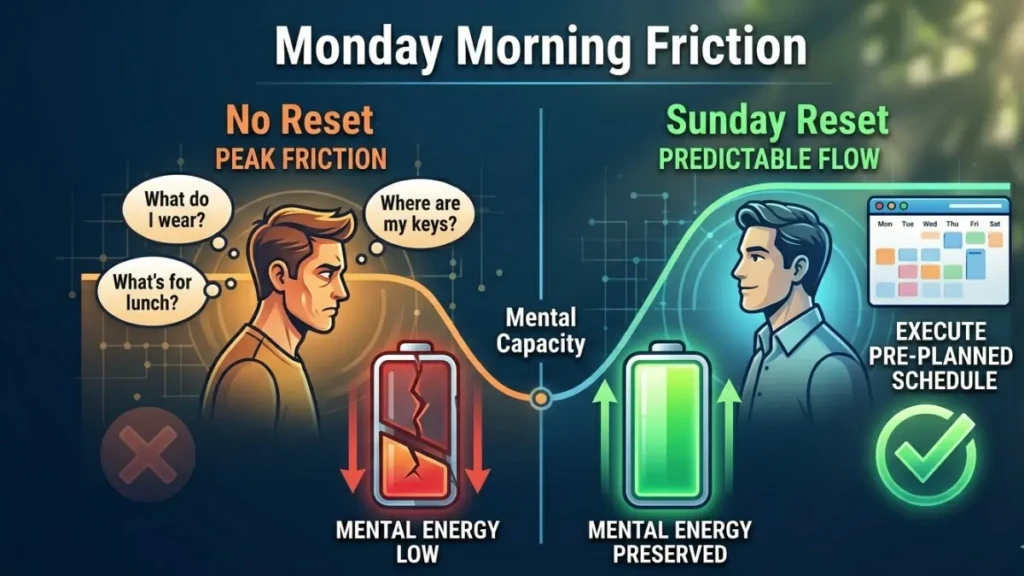
Every decision you make—from choosing an outfit to deciding what to cook for dinner—consumes a small fraction of your daily willpower. This is called decision fatigue.
If you start your Monday morning by making ten trivial choices before you even open your laptop, your cognitive load is already depleted. The core purpose of the Sunday reset routine is to batch-process all of your low-level logistical decisions on Sunday afternoon. By doing this, you preserve 100% of your mental energy for high-ROI tasks, deep work, and problem-solving during the actual work week.
2. Phase 1: The “Zero-Friction” Physical Reset
Your physical environment dictates your mental state. A cluttered workspace triggers a subconscious cortisol (stress) response. Your first step is to reset the baseline.
- The 15-Minute Tidy: Do not deep clean your entire house. Simply reset the “high-impact” zones. Clear your physical desktop, wipe down the kitchen counters, and put away the stray items that accumulated over the weekend.
- Wardrobe Automation: Check the weather and pick out your exact outfits for Monday through Wednesday. Hang them at the front of your closet.
- Fuel Preparation: Chop vegetables, cook a batch of grains (like quinoa or rice), and portion out your Monday lunches. When you are deep into a workflow on Tuesday afternoon, you will not have to break your focus to figure out how to feed yourself.
3. Phase 2: The Mental “Brain Dump”
The main driver of the “Sunday Scaries” is the background anxiety of forgetting something important. To stop this, you must extract the chaotic data from your brain and put it into a structured format.
- The Execution: Open a blank digital document or a physical notebook. Set a timer for 10 minutes and write down everything competing for your attention.
- What to Include: Work deadlines, personal errands, people you need to text back, bills to pay, and random ideas. Do not organize it yet. The simple act of moving the data out of your head and onto paper immediately reduces psychological friction.
4. Phase 3: The Operational Blueprint

Now that your brain is empty, it is time to build your predictable system for the week.
- The Top 3 Rule: Look at your brain dump list. Identify the three absolute most important tasks that must be completed this week to drive your goals forward. These are your non-negotiables.
- Time-Blocking: Open your digital calendar. Schedule your “Top 3” tasks into specific, uninterrupted time blocks (e.g., Tuesday from 9:00 AM to 11:00 AM).
- Batch the Noise: Take all the minor administrative tasks from your brain dump (replying to non-urgent emails, scheduling appointments) and block out a single 45-minute window on Wednesday to tackle them all at once.
5. Phase 4: Intentional Disconnection
A Sunday reset routine is not a full workday. It should take no more than 90 to 120 minutes. Once your physical space is prepped and your calendar is locked, you must execute a hard stop.
This is the phase of “Active Rest.” Close your laptop, put your phone in another room, and engage in an activity that completely disconnects you from your digital systems. Whether it is reading a physical book, going for a long walk, or engaging in a hobby, this deliberate rest signals to your nervous system that the reset is complete and you are safe to recharge.
Expert Insight: The ROI of Preparation
We spoke with a performance psychology coach regarding the dramatic shift in modern workflows.
“The highest-performing founders and executives do not rely on motivation; they rely on systems. The Sunday Reset is the ultimate upstream intervention. By investing just 90 minutes on the weekend, you buy back five to ten hours of lost productivity during the week. When Monday hits, you aren’t reacting to emergencies; you are simply executing a master plan that you already wrote.”
Frequently Asked Questions (FAQ)
Does a Sunday reset routine cure burnout?
It is a powerful preventative measure, not a medical cure. Burnout is often caused by a chronic lack of control over your schedule. The reset gives you that control back, reducing the daily micro-stressors that accumulate into total exhaustion. However, if you are experiencing severe burnout, you may need a deeper structural change to your workload.
What time of day is best for a Sunday reset?
This depends entirely on your lifestyle, but the “Late Afternoon Transition” (around 3:00 PM or 4:00 PM) is highly effective. It is late enough that you still get to enjoy a lazy Sunday morning, but early enough that you finish the tasks before the evening anxiety usually kicks in.
What if I don’t finish everything on my reset list?
The goal is progress, not perfection. Do not let the reset become another source of stress. If you only manage to brain-dump your tasks and pick out your clothes for Monday, you are still entering the week with significantly less friction than you would have otherwise.
Engineer Your Week
Stop letting Monday morning dictate your stress levels. By implementing a strict Sunday reset routine, you transition from being a reactive participant in your life to a proactive architect of your time. Clear your environment, structure your data, and guard your mental bandwidth.
Want to ensure your business systems are as optimized as your personal life? Read our masterclass on [How to Start a Business with No Money in 2026 (Low Investment Guide)].


10 Hidden Details You Missed in Stranger Things Season 5
19th Apr 2026[…] The “Sunday Reset” Routine That Will Completely Change Your Work […]